
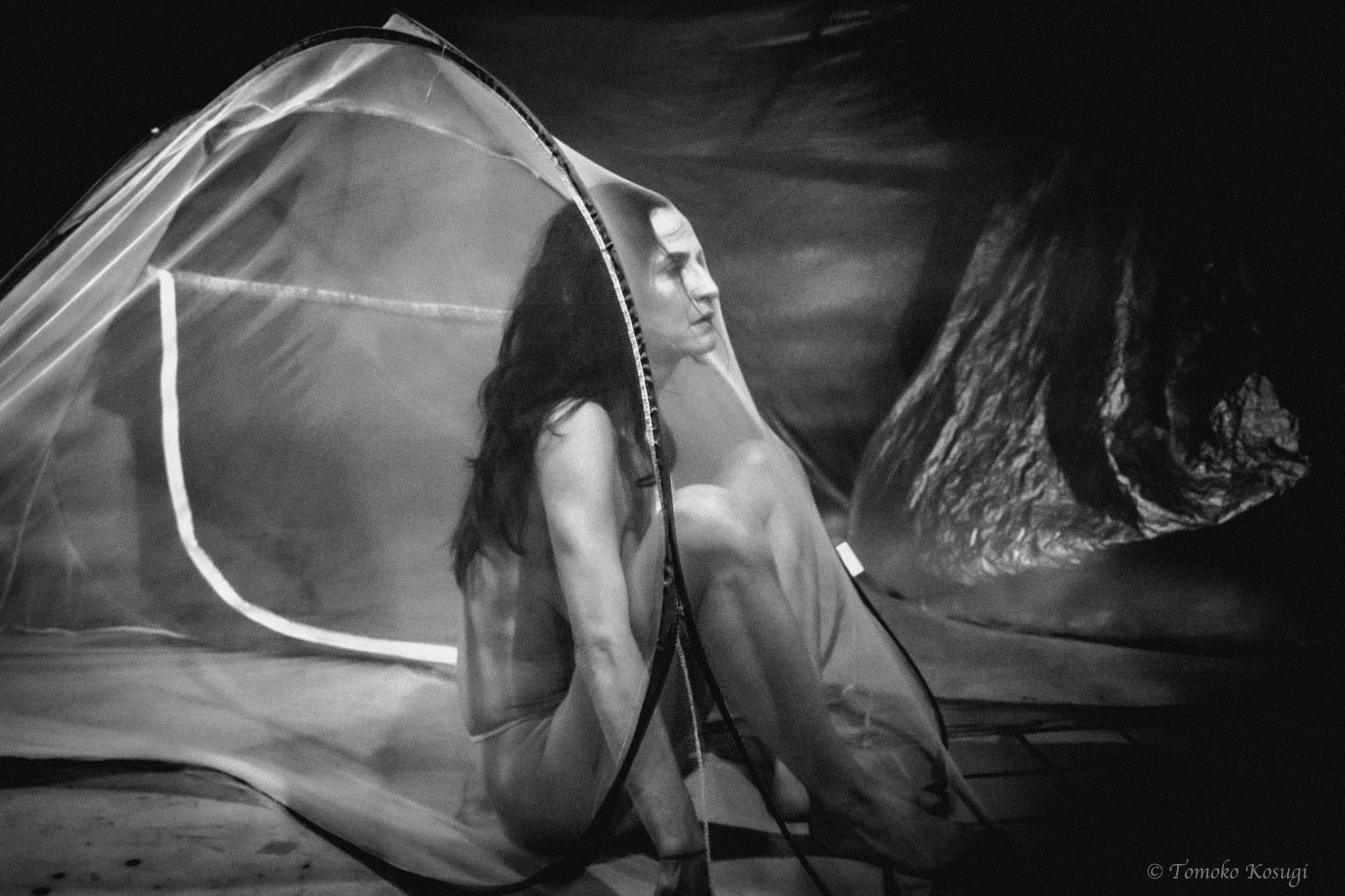
We conducted an interview with Joanna Rosenfeld, a German-British performance artist, theatre maker and Butoh practitioner.
Rosenfeld’s work is known for its raw vulnerability and explores themes such as trauma, mental health, motherhood, grief, longing and survival. Drawing from autobiographical material and improvisation, she investigates connection, time, and the environment, often expanding personal narratives into collective experiences.
The interview spans two separate sittings, with our first conversation set in Nakano, Tokyo, in a space close to where Joanna was rehearsing for an upcoming performance back in March 2025. The second session took place just over six months later, allowing certain thoughts and questions to return in different forms, this time near the Mori Art Museum, after we had visited the Sou Fujimoto exhibition together, and only a few days after I had seen her perform Memoria.
Across five chapters, the conversation moves between Joanna’s past and present, each opening onto a different part of her life and practice, with glimpses of the more personal and intimate moments that have shaped her along the way. We touch on her background and connection with Butoh, her experiences in Japan and her relationship with audiences in different parts of the world, before turning towards motherhood and, ultimately, death.
Joanna co-founded an experimental performance art theatre company named AboutFace Theatre Company UK, creating original touring work including EXILED (1999) and CLOSE UPS (2000). Following a range of artistic collaborations and works in film and theatre production and direction, Rosenfeld began dedicating herself to practising Butoh in 2017. Her recent performances include Resonant Void (2024), Luminous Ashes (with Conan Amok, 2024), Fragments of Silence (2025), and After the Eclipse (with Fumihiro Yoshino, 2026).
A Room of One’s Own

AXEL WANG:
When I saw you perform at Motoya’s1, Joanna, I got the impression that you were a professional dancer. But while doing research and looking through your website before this interview, I noticed you hold so many different titles, wearing a lot of hats! Based on the work you’re doing these days, which of those titles would you say best aligns with what you’re doing right now?
JOANNA ROSENFELD:
Performance artist. And I teach.

AW: Teaching in Brighton, England?
JR: Teaching where they have me. I’ve been teaching in Chichester and Brighton mostly, also here in Tokyo and Kyoto, taught in Taiwan, wherever I get a gig, so to speak. But back in Brighton I was teaching for a long time, at a drama school named Academy of Creative Training. Must’ve been what, 18 years?
AW: I spent a few years in Brighton as well, before university. Is that where you’re based now?
JR: I have been in Brighton for a long time, yes.

AW: How come?
JR: Well, love. That’s the simple answer (laughs).
AW: Oh wow, please do tell!
JR: Well, my journey’s a little bit complex. I trained as an actor at a city theatre in Frankfurt, Germany and was studying music at a conservatoire — but I didn’t like it. I kept arguing with the directors, and the dramaturge noticed and told me, “You should go to university, you’ve got a good head on your shoulders.” So I did — while still working. It was a five-year MA course, and I did that in Germany, and part of it involved going to the UK for a year — I ended up at Southampton University, studying just English literature and drama. After I finished the degree, rather than following my professor’s wish and doing a PhD, I decided I wanted to go back into working, no more academics.
So then I found this professional development degree, specifically in physical theatre in Liverpool, associated with the John Moores University. It was just a one-year thing and after that, I started a theatre company, which honestly wasn’t really theatre, it was more experimental theatre slash performance art really. That’s pretty much been the core of my work since. At the time I called it a theatre company because that’s how we could get funding. “Experimental art” just wasn’t going to cut it, certainly not with my background as I didn’t come through an arts college.

Physical theatre is super close to dance — like really close. Mime is part of it, clowning is part of it, physical control, acrobatics, all of those are part of it. I stayed away from dance for a long time, even though I trained as a dancer when I was a child because I was interested in narrative originally, I wanted to tell stories.
And then I started teaching. Since I’m German-born, and Germany has several very important playwrights, I naturally gravitated toward that. And one of them is Bertolt Brecht, a famous playwright and socialist, who lived in the 20th century, from the late 1800s up to 1956 — and I loved his work. Brecht wrote lots of musicals and you would know The Threepenny Opera (1928), and Mack the Knife (1928) — “When the shark bites with his teeth, dear..” — it became a jazz classic, but yeah, he’s a fascinating playwright.
Within about a year of starting my theatre company, I began teaching Brecht’s material. What I found compelling about Brecht was his whole take on how and why we tell stories. His theory was that the audience should never be in suspense. Instead, he wanted them to know what was going to happen, and that they should always be in a position of going, “I wonder how they’re going to do that”, rather than “What’s going to happen next?” The complete opposite of, let’s say, a Hitchcock film.

AW: That’s an interesting perspective.
JR: Yes, and I was really curious about that. For my first or maybe second piece, I was specifically exploring non-narrative structure, because at the time I was seeing more and more non-narrative, episodic cinema emerging. As I started studying film more seriously, I learnt that even in early cinema, the brain works in a totally different way than Brecht assumed. He got it wrong, I thought. The brain automatically creates narrative from, or makes a story out of, unrelated images, as long as they’re sequenced in order.
There’s this filmmaker, Sergei Eisenstein, one of the early Soviet directors, who made the famous Battleship Potemkin (1925). He created these fast-cut film collages and was dubbed the “father of the cut.” And I realised: it’s the same with live performance. If I show you something non-narrative on stage, your brain will still try to make sense of it, and will still try to build a story.
AW: I think that’s what audiences do.
JR: Brecht believed that if you stopped the audience from emotionally engaging and told them what was going to happen, they’d stay in the intellectual, cognitive part of the brain. But I don’t think that’s how it works. Once I understood that, I was totally liberated from narrative in my work.
AW: Is that how you got into dancing?
JR: Well, I call it pure movement rather than dance. When you called me a professional dancer — that’s interesting — I wouldn’t say I’m a dancer, but I do use dance in performance. I see myself more as a performance artist with certain physical skills that allow me to use my body in a kind of dancery way.
AW: But how did you end up in Brighton (laughs)?
JR: Oh yeah, that story (laughs).
So I was in Liverpool, developing my second piece, and I bumped into this man — it’s actually kind of a cute story. He was performing in a theatre show where I happened to be the fire officer. You know how it is when there’s no money in a company — you end up doing everything: theatre, front of house, bar, you name it.
As fire officer, my job was to check all the fire exits and make sure nothing was obstructing them. Then during the performance, I’d sit in the audience and watch — not just the show, but to keep an eye on safety. It was really cheap labour, hardly any pay, but you got to see the shows for free.
The theatre’s called the Unity Theatre, a black box space with a raked seating area. The audience would enter from the top then walk down to their seats. Although it holds about 600–700 people, it feels incredibly intimate and small. What happens is that, if the show is not full, people would always fill from the top, never the front rows.
And this show where this man was performing, it wasn’t full. So the top four or five rows were packed, but as the fire officer and a performer myself, I knew the best seat — fourth row. So I sat there, completely alone on my own in that section of the auditorium, while everyone else stayed up top. Totally ridiculous.
Anyway, the show happened, it was called The Man Who Stole a Winter Coat by Patrick Dineen — a really beautiful musical theatre piece, with about eight performers. And there was this one scene where one of the actors had to sing to one audience member. I was the only one in this man’s line of sight — there was no one else but me — and he sang directly to me, and I was just like, “Oh… this is very beautiful, I actually really like this.” (Laughs)
AW: How old were you back then? Do you remember?
JR: Early 20s, and yeah, it was a very special moment.
After the show, I told him that I really enjoyed it. And he went, “Are you going to come see it again?” I said, “No, I’m on another shift,” so I didn’t. But the company came back with another show, so I went to see that, and we had a little chat. Then, about a year later, the original show toured back to Liverpool, and we bumped into each other at a café.


AW: That sounds like a beautiful love story.
JR: I remember going up to him and saying, “You don’t remember who I am, do you?” And he said, “No, but I think I should.” That night, he found me at the theatre — I was still working part-time there, and the rest is history.
We fell in love. He lived in Brighton, in this beautiful little house he owned. I was in Liverpool, living in a slum, burnt-out buildings across the street, no central heating, and one of those electric meters you had to top up.
AW: I remember using one of those when I lived in Northampton.
JR: Yes, with those little cards. And when the electricity ran out in the middle of the night, you had to run to the corner shop — all of them had plexiglass and tiny little hatches to serve you through, because there was so much crime in the area.
So when we decided we wanted to live together — we’d started this long-distance relationship — it was like, “Where should we live?” This lovely little two-bedroom house with a kitchen… Or my one-bedroom mess in a flat, where you can see people getting mugged, someone throwing up in the backyard, and underneath there’s a drug dealer, and underneath that there’s an alcoholic.

AW: Sounds like a no-brainer, eh?
JR: It was!
However… However.
It was also a very stupid thing for me to do, because… You’ve lived in the UK, so you know, the northwest — Manchester, Liverpool, Leeds, Sheffield — it’s thriving culturally, and it has a proper identity. And it’s full of cheap spaces, mostly because of its post-industrial state, still a little bit downtrodden on the out, so when I was living and working in Liverpool, I had access to incredible spaces. I could really work on my practice. I could be in warehouses performing week after week for next to nothing — or actually getting paid — I was able to get funding straight away for my first project. It was fabulous being in Liverpool. Moving down south to Brighton for my career was an absolute self-suicide. It was insane.
Absolutely insane.
Brighton’s only an hour on the train from London, which sounds great — but funding-wise, it’s a desert. Because London’s right there, it pulls in all the money and all the good artwork. There’s no identity there other than the Brighton Festival and the Fringe2, which is just a one-month event each year. Other than that, there is just no culture. Everything is in London. And it’s a really expensive tourist town with London prices. So career-wise, it was an absolutely idiotic decision.
AW: Is this early 2000s?
JR: Yes, it was. To be honest, in the early 2000s it was still kind of okay — the government was still giving some money to regions, even those close to London.
But when the government changed3, all centralised funding to Brighton was cut. So the city had to rely entirely on its own income to keep things running. And all the cultural things have been cut to shreds. There was barely anything left, barely anything.

AW: Were you born in Frankfurt, Joanna?
JR: No, I was born in Dortmund, but I grew up in Frankfurt.
AW: You still have family there?
JR: Yeah, my parents are still there, and I go back to visit them from time to time.
There’s actually a sad reason why I stayed in Frankfurt for university. My brother — he passed away — had haemophilia. It’s a severe genetic bleeding disorder, especially serious in boys. In the early ’80s, a lot of people with haemophilia were infected with HIV through the medication. My brother was one of them, he became HIV positive, and we always knew he’d likely die young at some point — and he did. He passed away the year before I finished my master’s. I chose to go to university in Frankfurt because that’s where he lived and I wanted to be close to him. And as soon as he died, I left for the UK.

AW: Would you say the UK is home to you now, especially since your kids are there?
JR: It has been.
I’ve got two daughters — Katarina, she’s 22 and studying fashion at Central Saint Martins; and Alexandra, she’s 19, just finished her A-levels and is on a gap year.
To be very honest, since Brexit, England does not feel like home anymore. Maybe I’m like you — I don’t really have a home. I’ve been in Japan for almost seven months now, and I’m really happy here. But I think I could be happy anywhere, as long as I’m doing work I care about, and making meaningful connections through the work I do.
So I’m not sure how much longer I’ll stay in the UK.
I had this conversation weirdly yesterday with my daughter. I’ve been invited to come back to Japan in October for a festival, and she was shocked. I told her, “But honey, there’s nothing for me in Brighton.”
Footnotes
1. Motoya Kondo (近藤基弥) was born in Nagoya, Japan. He is a choreographer, dancer, and co-founder of Motimaru Dance Company. He studied the dance of Butoh (舞踏), one form of traditional Japanese dance, with Yoshito Ohno (大野一雄) and has conducted fieldwork research on local and traditional dances in India, Nepal, and Bali. With performances and teaching engagements across over 40 cities in Europe, Asia, and Australia, Kondo bridges contemporary art practices with Eastern contemplative traditions, influenced by Tibetan wisdom.
2. Brighton Fringe is an open-access, multi-arts festival held annually in Brighton, featuring performances and events across theatre, dance, comedy, music and other art forms in venues throughout the city.
3. Refers to the shift in UK government policy around 2010, when funding under Labour’s peak during Tony Blair’s era gave way to austerity measures introduced by the Conservative-led government under David Cameron, resulting in significant cuts to arts and regional funding.
4. Trinity Laban Conservatoire of Music and Dance is a London-based institution specialising in music, contemporary dance and musical theatre.
Credits
Editor: Axel Wang
Photography: Courtesy of Joanna Rosenfeld