
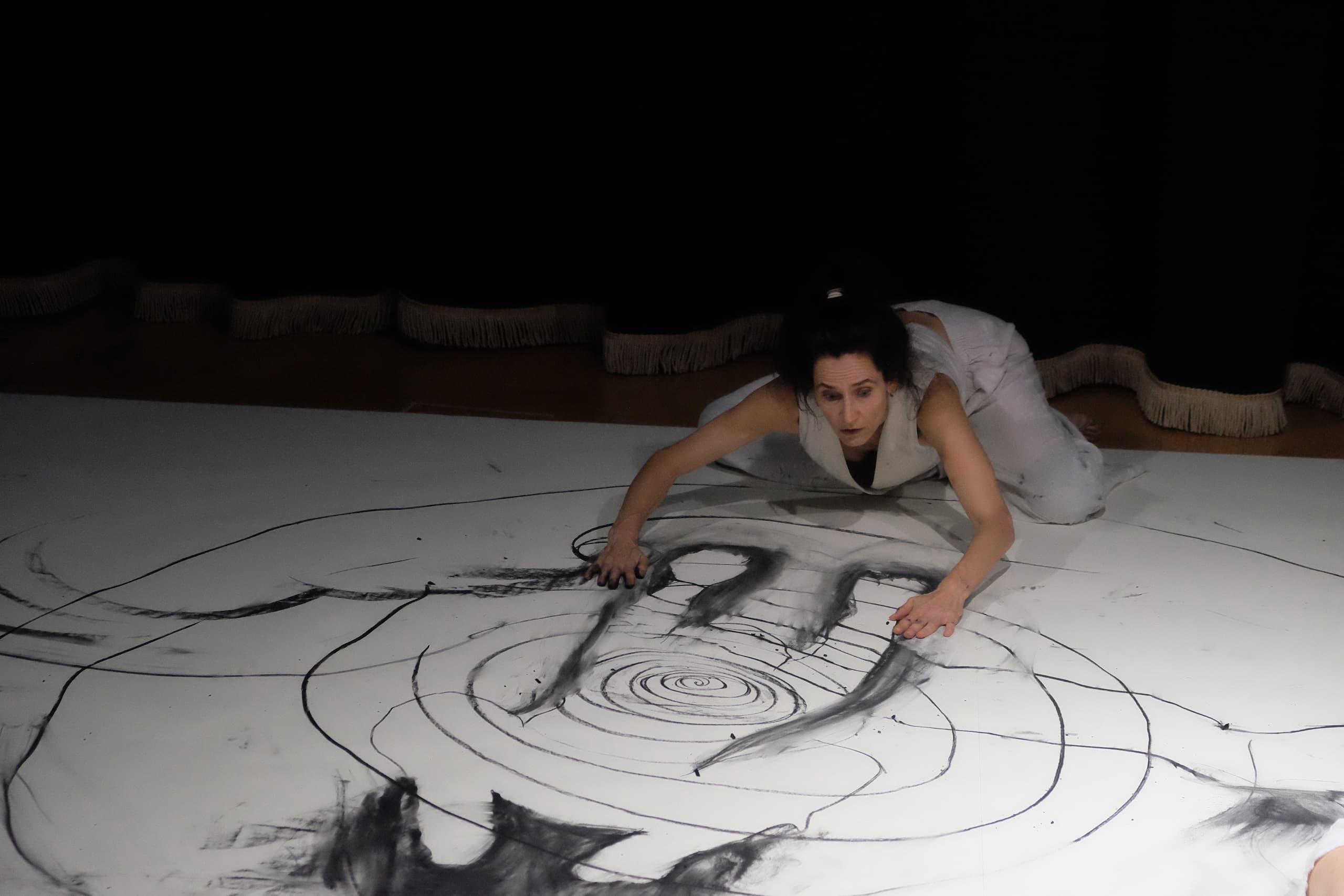
The Metamorphosis

AXEL WANG:
Let’s talk about Butoh.
JOANNA ROSENFELD:
‘Cause that’s what you saw.
AW: Yeah, and that’s what I thought you did.
JR: It is what I do now.
“As I began to understand it more, it occurred to me that
I’d probably always been doing Butoh, because it genuinely felt like I was coming home.”
AW: How did it all begin, what drew you to it initially?
JR: Actually, initially, I was repulsed. Some friends encouraged me to check it out, so I looked up some images online — and I just found them really repulsive. Old men in drag, white-painted bodies, twisted expressions of pain, extreme postures of distress. I just thought, I’m not sure this is something I’m interested in at this moment in my life (laughs).
And that’s coming from someone who’s worked a lot with the grotesque. I was trained in Commedia dell’arte, which is a traditional form of masked performance from Italy — it’s ancient, grotesque, and I love it. But Butoh? I was just repulsed.

Then I was working on a piece — still unfinished — called We Need to Talk About Death. I made an 18-minute version, though it should be a full hour. And in that piece, I use archival material — specifically, documentation of grief. One of the first home video cameras I ever had was given to me by my uncle, way before we had these (smart) phones and things. And about a year later, he killed himself.
On that day, when he took his life, I was alone in my flat in Liverpool, I was quite new in the city and I didn’t know what to do, so I turned the camera on and filmed myself in that moment of grief. I just talked to myself on camera about his suicide — raw, immediate, unfiltered.
I did the same when my brother died, but that wasn’t immediate — he died before I had that camera. But my uncle’s suicide, that was an immediate response, literally within five minutes of hearing the news, I put the camera on and filmed it. I know it’s an odd thing to do, but I felt this intense need to capture the reality and keep a documentation of that extraordinary moment. My uncle was in his mid-50s, he jumped from a skyscraper, damaging the roof on the way down, and my aunt had to pay for the repairs.
AW: Shit…
JR: The whole thing is just mad. In retrospect, we all went, “Oh yeah, he was a bedwetter all his life”, or “He was an alcoholic, lost his driving licence several times”, or “Maybe he should have had therapy”, but nobody actually encouraged him to do that.
Having worked in primary school as an art and drama teacher, I’ve watched how children play out the theme of death — they have no qualms — and they kill each other off all the time (in their games), and they really go through the details. But then there’s a point where we all stop talking about death. When someone says, “Oh, I lost someone”, that’s usually the end of it. We don’t ask how, because that feels intrusive, and we don’t give people room to talk about it.


I’ve been doing work around mental health as an artist, leading workshops, and some of the stories really stay with me. There was one mother who gave birth to twins, one died, the other survived with a disability. After three months, no one wanted to hear about the baby who died. When I met her, her son was 18. And all she talked about was the dead baby — not the one who was alive — because no one had ever let her speak about it and she finally had the opportunity. She’d been bottling up all these stories about her experiences for 18 years, nobody wanted to hear what happened to her, because it was too ugly, or distasteful, or made them feel uncomfortable. I don’t know how cross-cultural this is but this is very common in Europe.
Anyway, I used that archival footage in a performance in 2018 — raw, with sound, projected with loudspeakers. The piece had pure movement, it had poetry, I played with toys using Lego figures, and closed-caption cameras that also projected death scenes, basically reenactments of how people I knew had died, like my brother, and others. It’s been performed a few times in Brighton and Manchester, though I felt that it’s still missing something and it needed another layer of grief that was more reflective, that wasn’t raw. Butoh is called “the dance of darkness”, and people describe the Butoh dancer as a moving dead body. I think that’s when I became intrigued and decided to participate in workshops — and I loved it, then I joined another, and it just snowballed. By now I have probably worked with 25 or more different teachers.

AW: So you first encountered Butoh quite a while ago then.
JR: Seven years ago. As I began to understand it more, it occurred to me that I’d probably always been doing Butoh, because it genuinely felt like I was coming home.
I was a very odd child. I’d do these grotesque things (she puts her legs behind her head), just out of nowhere, all the time. I talked to myself in kindergarten. In primary school, I’d walk around on my hands, I was always doing this strange stuff. And the more I learnt about Butoh, the more I recognised that in myself.
It was strange — because I had the form, but not the cultural context. That’s part of why I’m on sabbatical here, studying more with Motoya in Nagoya. And now here in Tokyo, I’ve been spending a lot of time at the Keio University archives, really digging into the practice of the original artists — who are all gone now. I wanted to learn more about the cultural context of where it came from, and the significance of form for those artists and what they were trying to do.


I’ve been working on Butoh for about six years now. Then of course COVID hit — and for three years, nothing happened. Nothing significant culturally anyway, apart from me running an outdoor Shakespeare festival, which was intense. There was literally no funding for my own work but I did continue to train and perform in others’ works.
Then a Butoh dancer — now a close friend — came to London to perform in a David Glass Company piece called Seven Brides. She performed a Butoh section and also led a workshop, which I attended. She’s based in Tokyo, and I completely fell in love with her practice. Later, she invited some of us to come and work with her in Japan. I jumped at the opportunity. The timing was right — my daughter had just finished school — I came to Japan and performed in Yamanashi Prefecture, that was October last year.
Butoh in the UK is much more about virtual spaces, but in Japan it’s all been live, live, live. I have a big question about how to make performance art more accessible to the younger generation — because there’s definitely an age gap, partly to do with time and money available, and they also choose to spend more time online, gaming and stuff.
You probably know this, but the gaming industry is now the largest entertainment sector in the world, and it’s starting to open up to performance in some interesting ways. As performers, we’re now competing with gaming, TV, YouTube, streaming platforms, and cinema. And while cinema is slowly declining, streaming, home-made content, and gaming are booming, though they tend to be solitary experiences, and aren’t necessarily interactive or immersive in nature. And I do think immersive theatre and performance still have huge potential — but we have to think differently about access, formats, and how to reach people where they are.
AW: I feel like I want to come back to this in a bit.
Do you remember when I saw your performance at Motoya’s, I told you on the spot that it reminded me of a Yoko Ono piece1. And you said you’d visited her exhibition at Tate Modern (YOKO ONO: MUSIC OF THE MIND, 2024) multiple times. Would you say she’s one of your influences after you started practising Butoh?
JR: She’s prior. I’ve loved her for a long time. Yoko Ono is a performance artist. And I identify as a performance artist. Ono, along with Laurie Anderson, and also Marina Abramović — those three are my goddesses, my heroes.
“Can I be you when I grow up? (Laughs)”

They each have different elements of guts that I adore. And radicalism in a form that I really love, even though none of them leans into the grotesque. I love how they transgress out of theatre, they’re not creating theatre, and I love how their works speak to everyone.
Yoko Ono, specifically through her collaboration with John Lennon, managed to enter popular culture in a way she hadn’t been able to before, despite being a part of the avant-garde art scene here in Japan for years. That’s when Butoh was born, she and Tatsumi Hijikata2 were acquaintances. It was very small — influential — but very small, and she became global because of John Lennon. I’m not saying that’s what I want at all, but I really admire how she managed to keep her integrity in that environment.

AW: You mentioned this language of contact improvisation earlier, can you tell me more?
JR: It’s an improvised dance form that originated in the United States in the early 1970s, developed by Steve Paxton and a few others around him. It’s based on using physical body contact to explore movement and create performance, and it’s practised both by performers and by lovers of the art as a hobby.
I first came across it through a university lecture when I was 21, and I’ve been doing it on and off since then. For me, it’s a performance practice. In contact improvisation, we work with shared gravity — what might look like lifts can happen, and there’s often a sense of fluidity as well as an acrobatic element in the performance that wouldn’t be possible without. But it can also be quite dangerous — I’ve got this bruise on my nose because someone elbowed me in the face two days ago. (Laughs) Accidentally, of course.
AW: Is it standard practice for all Butoh artists?
JR: Not at all, but it’s been a consistent part of my dance practice. I didn’t train in ballet, I trained in modern contemporary and contact improvisation. And contact improvisation is, well, mostly improvisation, there are certain techniques and forms you learn, so it never gets boring for me because I’m ADHD (laughs).
“…what I want to do is to transform space, to create something that makes the audience feel something — feel different from how they did before watching the piece.”
AW: While you’re on sabbatical here, you’ve been working closely with Conan Amok (阿目虎南)3. I’d say he’s quite an active figure in the Butoh scene, having also been involved with Dairakudakan (大駱駝艦)4 at an earlier stage. What is it like working and collaborating with the guy, what have you learnt from him?
JR: We met in Romania at a Butoh retreat where he was teaching, maybe two and a half years ago. Conan wasn’t choreographing — just teaching and hosting workshops, we happened to be in the same piece and we just clicked, really clicked. He was interested in what I was interested in, which is bringing contact improvisation and Butoh together to see what might emerge in performance.
So we did some exploring in our free time there, and decided we wanted to pursue it further, after he went back to Japan, me the UK, we made a dance film remotely, we also did apply for several grants and eventually got funding from Dance Base Yokohama5 to make a piece — one of the reasons I’m here now.
Dairakudakan comes directly from Tatsumi Hijikata’s line — who’s all about body training and getting into form through the body — and they have a very strong choreographic tradition; Kazuo Ohno (大野一雄), on the other hand, emphasised training the imagination and getting into the form through the imagination, the body follows; Akira Kasai (笠井叡), I don’t know him well, I think he was studying in Germany for a bit, either way, he remains an influential teacher and is based in Tokyo right now.
What I’m learning from Conan is how to choreograph and fix form. My own practice is structured improvisation: I work with clear content, imagination, and defined start and end points — but how exactly it unfolds, every time it is different. Conan, by contrast, will count in three 8s, four 8s, five 8s, six 8s — he fixes everything.

AW: You’ve been in the performing arts business for a while now Joanna, as you’ve said, it’s not entirely different from dance — even Butoh — they go hand in hand, to some extent. Since starting Butoh, do you still find it challenging, the choreographies for example, do you still see them as challenges?
JR: Yes, absolutely. Every piece is a challenge. I performed a new solo, Fragments of Silence, last Wednesday (19 March 2025) — a collaboration with a musician called Hoshi, a cellist and flute player. The challenge for me is always to create something with transformative potential, both for the audience and for myself.
The challenge lies in where, it’s very easy in performance — that goes for all performances, dance, theatre, performance art — to just deliver form. And I would say that, at the event you saw at Motoya’s, maybe some dancers were just delivering form. But what I want to do is to transform space, to create something that makes the audience feel something — feel different from how they did before watching the piece.
That’s the challenge, every single time. And when I look at Butoh’s founders, Hijikata and Ohno, that’s what they were after too. Thus part of the methodology is not to entertain, though Dairakudakan might be slightly different, they have an element of entertainment in their performances — the colours in the eyes are not quite the same in that sense. Maybe that’s why Conan and I work so well together because we benefit from each other’s experience and strength.
For me, the form can be as beautiful as anything — but if it doesn’t touch the audience, it’s pointless, to be frank, it’s just a wank, you might as well not invite an audience.
“Why am I doing this?”
The question of “why” is important, and sometimes the “why” is because I’ve been invited, that’s the practical reason. But the real reason why I’m performing needs to be something else.
And it’s dangerous sometimes. I heard about a dancer, who came to Japan to perform a Butoh dance after the reactor meltdown, to dance for the dead. She’s Japanese but doesn’t live here anymore. I don’t know how the dance went, but I do know it upset a lot of people — it was very soon after the disaster, and the people I spoke to felt that the dancer was using the tragedy to gain publicity. I can’t say if that’s true — I don’t know the dancer, but yes, it’s dangerous territory.
“Am I a shaman?”
No.
“Do I want to create and perform shamanic death rituals for earthquake victims?”
No.
“Is that my role?”
No — I’m a performance artist.
“Do I want to use potent material to create something that somehow touches the audience?”
Absolutely.
What I find interesting in Butoh is that we don’t communicate nor explain the materials we use nor what we’re thinking when we perform something. As an audience, you’re confronted with the imagery and it evokes something in you. It’s not like theatre, where you have to understand it. You experience Butoh, so that gives me incredible freedom to use whatever material I like.
Actually I had a conversation after the solo on Wednesday with an audience member about touchy material. I admitted to him that I used the Holocaust for the performance — it was just a very short moment — ashes flying up the chimney of the crematorium. Now, I have Jewish ancestry, and some very distant relatives of mine were in Auschwitz — that’s close enough. And we talked about how close is too close. The dancer I mentioned earlier, that felt too close. Hijikata used Holocaust materials in his choreography for example, but he never touched Hiroshima or Nagasaki. Maybe that was too close for him, he never worked with atomic bomb material, ever. But he did work with other horror that was slightly further away.

AW: You wrote that you’ve often asked yourself: Why Butoh? What is Butoh? Is this Butoh? Do you think you’ve found the answers to those questions?
JR: I’m letting other people decide whether what I do is Butoh.
AW: Have you simply learnt to stop asking yourself those questions then?
JR: No, I’m still asking myself those questions:
“Is this Butoh?”
“Does it just look like Butoh?”
I suppose there’s a kind of inner knowing that I have formed about what Butoh is. For me, Butoh is a radical practice of non-narrative performance, it’s radical because it has no taboo, and that’s where it crosses over with my practice, I’ve become more radical since I encountered Butoh, because now I have a context where I can be as extreme as the fuck I want. For example, yesterday I performed an improvised piece with a man who’s 87, and I sat on his face.
AW: Is he a dancer?
JR: He’s a Butoh dancer. So we improvised a Butoh piece together and he was playing with masculine power, he had a stick in his hand, and kept hitting things and people. In the performance, I de-weaponised him, and I sat on his face.
AW: What happened afterwards?
JR: (Laughs) I don’t quite remember, I think I danced with something else.
That for me, is sort of the Butoh thing. You don’t necessarily follow the narrative. We could’ve developed the narrative since he played this kind of patriarchal and prosperous character the whole time — but I didn’t want to, though I did want to take the weapon away from him and ended up sitting on his face (laughs).
I was wearing only little shorts, very few clothes. Sitting on a man is one thing; sitting on someone’s face is another; and sitting on an 87-year-old man’s face is a completely different story. It was far out, and it was a triumph, there was a triumph about this taking over the ancient patriarch and battling him, and there was sexuality somehow in there. But Butoh allows me to play with everything.
You’ve seen my solo which is different of course. Solos aren’t as sexual because there’s no one to be sexual with, really, though there can be (sexual parts) — duets, trios, quartets, group choreographies — sex is a big thing. Hijikata’s golden phallus is a famous one from the Rebellion of the Body6, I think it’s in a museum somewhere (laughs).


Footnotes
1. Refers to Yoko Ono’s Bag Piece (1964), a performance in which performers enter a large black bag, transforming the concealed human body into a shifting, ambiguous form.
2. Tatsumi Hijikata (土方巽, 1928–1986) was a Japanese dancer and choreographer who founded Butoh, a radical form of dance that emerged in postwar Japan. His work challenged conventional ideas of beauty, movement, and the body, profoundly influencing experimental performance and contemporary dance.
3. Conan Amok (阿目虎南) is a Japanese choreographer and dancer rooted in Butoh, known for his “Multi-layered body” method that fuses phenomenology, sculpture, and design. His performances blend sharp physicality with wild gestures, exploring themes of distance, transformation, and the everyday through a choreography of disconnection and transience.
4. Dairakudakan (大駱駝艦) is a pioneering Butoh troupe founded in 1972 by Akaji Maro (麿赤兒), renowned for its theatrical scale and the philosophy of Tempu-Tenshiki (the universe is perfect).
5. Dance Base Yokohama (DaBY) is a contemporary dance hub in Yokohama, established to support professional artists through residencies, workshops, experimental performances, and dance archives.
6. Rebellion of the Body (肉体の叛乱) is a foundational essay-manifesto from 1968 in which Tatsumi Hijikata articulates Butoh as a radical rejection of modern aesthetics through the body’s grotesque and primal potential.
Credits
Editor: Axel Wang
Photography: Courtesy of Joanna Rosenfeld