
The Theatre and Its Double
AXEL WANG:
You’ve performed in so many places, does the experience vary between cities?
JOANNA ROSENFELD:
It varies enormously.
AW: How so?
JR: What people are going through, the atmosphere of a place, change the way I operate. It’s one of the tragedies, I think, about artists who work in many places because, the work I do is both sensitive to the place and anchored in my autobiographical experience of life.
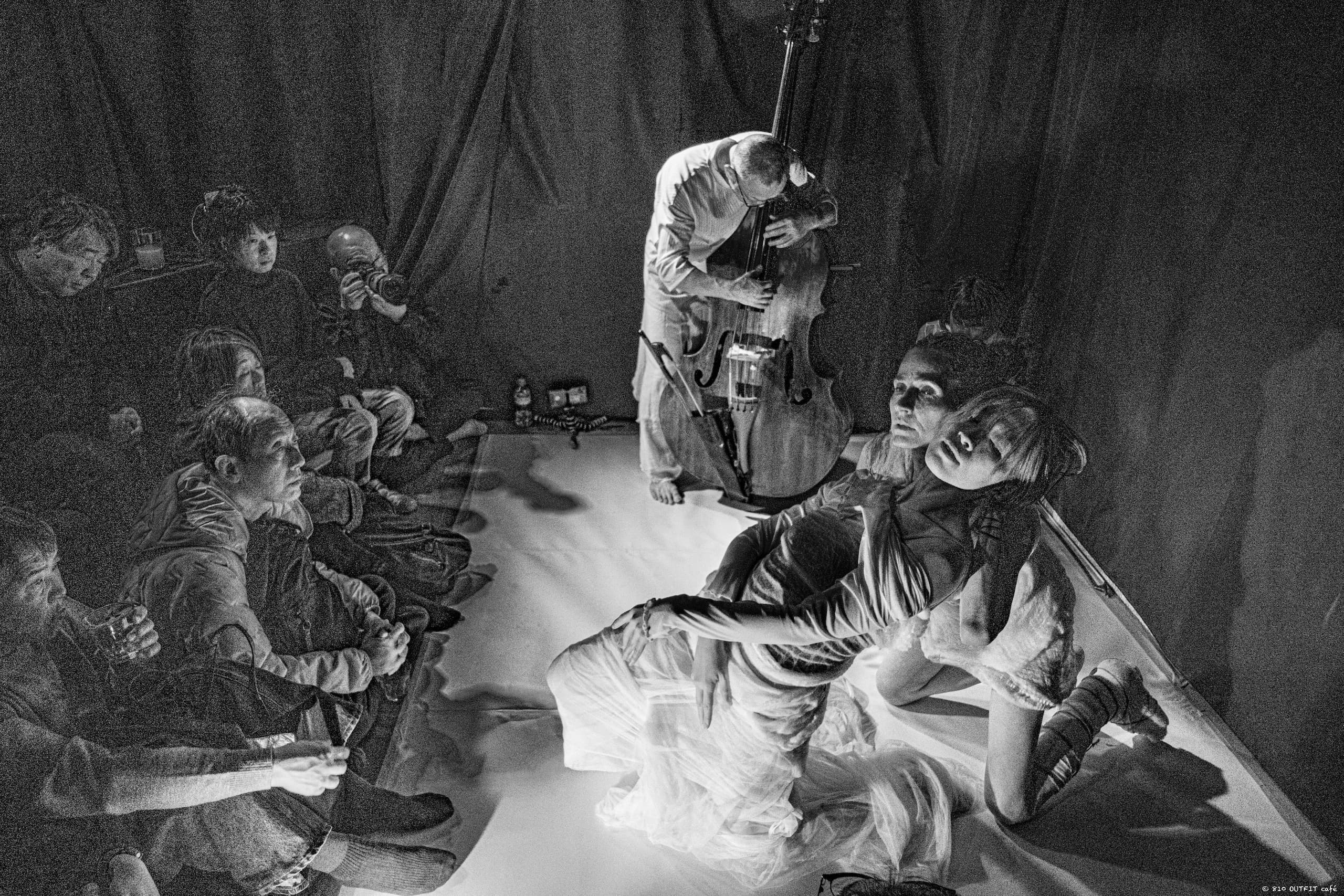
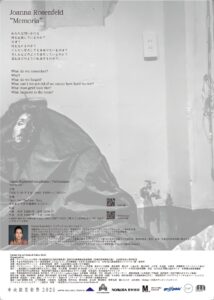
A film is different. If you create a movie, then it can go anywhere — in the Outback or on your screen, whatever — and you consume it. But that’s not what I do. The reason why the shutters were open for the performance you watched (Memoria, 4 October 2025) was that this piece of work was not just for the few who chose to come in. There were lots of people walking past, being stopped in their tracks to observe a glimpse of something that was completely strange and unusual. And that works with the ethos of that specific space.
I wanted to recognise that this specific space brings art to a community that’s actually pretty starved of that kind of experience. Yes, it’s on the outskirts of Tokyo, it’s not an up-and-coming or hip place, the building itself is very old, right next to the railway line. There’s a lot about it that shouts, “Art doesn’t happen in this community”, and “We don’t have access to art.”
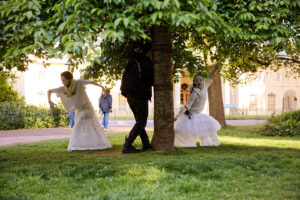
And so I talked to you before about the outdoor Shakespeare performances — how to make art available to people who don’t feel they have a right to experience it, or don’t have the capacity or desire to experience it. There’s this idea of what’s called Invisible Theatre, where we bring theatre into social spaces in order to create a discussion, a response.

I don’t make it invisible. The theory is that you might, as actors, bring a scene into the Tube and people don’t know whether it’s real or not. They think it’s real, and so they’ll respond as if it’s real. That’s not what I like to do. My performances are clearly performative, but I find it very interesting, as an onlooker, to see people confronted with this kind of art and to watch them watching it.
So yes, to come back to your question, does every city work in a different way?
Yes, it does.
Working, for example, in Taiwan, people really come to things. They really come. They hear that somebody whispers that something’s going on, and suddenly you have a huge crowd of people observing, which changes the atmosphere and there’s an excitement for that group of people. They’re hungry for experiences, maybe because it’s a very small island, and there’s not that much coming and going. While in other cities, people are almost too shy to engage with things.
AW: Like in Japan?
JR: Well, in Japan I haven’t experienced that. I’m thinking more about England — maybe Japan and England are similar in that there’s an embarrassment in admitting that you’re curious. Not so much in Canada and America, or Germany either — they want to engage when they want to engage.
And then in England, you have a completely different response to performance, which is disruption, or destruction, which I haven’t encountered anywhere else. We were performing in a park where the performance was ticketed, but you could still observe and hear it from outside the ticket gate. And suddenly, there were items being flung over the bushes. The people flinging them were, young people, who couldn’t actually see where the items were landing, and there were lots of people on the other side of these bushes. So, there was a real attempt to disrupt, and potentially hurt people.
It was just fascinating. They couldn’t just accept that there was something going on. They had to somehow get involved with it… Mmm…
And I experienced something similar in Liverpool, where we were doing street theatre. People got in the way on purpose and sort of tried to have a fight with the performers while they were clearly in character, wearing 1920s costumes. And so that kind of, um, engagement, I haven’t seen anywhere else. But again, it’s very specific to the place, and it’s very much cultural — specifically, maybe, working-class culture in England.
AW: Never thought of it that way, I just thought it’s chavs being chavs (laughs).
JR: I think it’s something about, again, access and entitlement. So, if I don’t feel this is for me, then I’m angry at it happening in my neighbourhood. If I don’t feel like I’m being invited in, then maybe my reaction is to shut it down. So, it’s not about chavs being chavs, but about how I make work that invites you to engage with it, to feel that you’re part of it.
If I make the decision to perform in your environment, then I need to respect that community. And hence, I said it’s a tragedy about the travelling performer, right? Because we quite often don’t have enough time to really get to know a community. And so, it does feel like we plunk our performance pieces into this community and expect people to just sort of respond to it as if it’s some sort of universal, generalised mash. It isn’t. It never is.
Every place has its own story, and to do the research properly, we have to spend time. I know of one artist who is a friend of mine, Tristan Sharpe. He spends about three months, if he can, getting to know the space and the community before making a piece. He just sits in the space for a long time and feels the atmosphere, feels what the space is like.
And every place has different communities, and with that come different forms of engagement. And my role changes when the place changes. In European or American contexts where I pass as a local, I’m seen as just another performer. When I perform in East Asia, I’m quite exotic, you know. And I know that exoticism is part of the relationship with the audience — that I’m being seen as unusual, as not from here and not belonging here.
“I’m too visceral for them, too raw, too confrontational.”

AW: But are you comfortable with the exoticism?
JR: Yes. I am comfortable with that, it’s just the truth. I do look different and I’m not from here. And there are cultural norms that do not apply to me being here because I get that privilege. There are norms that I can transgress, even though I know they exist, because of that.
I embrace my multicultural background, and I think that allows me to very consciously break and challenge boundaries. But if I were an Asian woman, I probably wouldn’t be allowed.
There’s a reason why there are a lot of Butoh dancers of Japanese heritage in Europe. Some of the early Butoh burlesque work from the ’70s was too outrageous for European audiences, and it had to be shut down even though it had been touring in Japan for years (laughs). Very interesting, again — where’s the boundary between cultures? Where is the grotesque meeting the erotic? Where’s the repression? What is being repressed, and in which context?
Maybe if it had been Europeans doing it in Japan, it wouldn’t have been okay either. There’s a level of strangeness that we can accept. And if it had been European performers in Europe, maybe it would’ve been acceptable. But because they were Japanese performers, which made it exotic in Europe, it wasn’t acceptable.
AW: While you’re performing, do you notice the audience at all? Do you pay any attention to what they are doing, or do you just focus on your own thing?
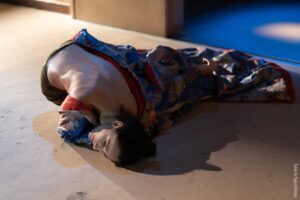
JR: No, I don’t focus only on my own thing, but I don’t have a prescriptive idea of how you should be responding. ‘Cause I don’t know what each individual audience member is going through when they’re observing. So, Memoria (2025), for example, the American guy, I think the piece really resonated with him because he was grieving someone, so being swallowed up by this black mass and disappearing, and trying to come back out, actually really, really, did something for him. While for you, it wasn’t resonating, and that’s also fair.
I’m not there to entertain, I’m not a clown. In that sense, it’s a bit like when we went to that exhibition (The Architecture of Sou Fujimoto: Primordial Future Forest / 藤本壮介の建築:原初・未来・森, 2025, Mori Art Museum) just now and I went through all sorts of emotions (laughs) — feeling overwhelmed, hating him, loving him in my head. We all have that.
Each audience member has these different responses, and I’m not there to… I’m not Spielberg. Spielberg likes to control what people experience. He’s kind of a director who goes, “I’m gonna give you an experience and everybody should have the same.” And I’ve seen it in Broadway, how it’s being managed. The audience gets measured every day, and if they don’t quite respond according to the planned outcome, if they don’t laugh as much, the production gets changed. That’s not at all what I’m creating.
I’m creating a space where each individual audience member can have their own response to the work. There’s no right or wrong because I’m asking questions, and all the questions you might have are valid. I love a walkout — you probably would have been a walkout (laughs) — I really do, because it means it’s not just bland, “Oh, I can sit through this.” I don’t want that. Your reaction is completely legitimate, and I’m aware of it. I’m not protecting myself from it, either.
The same event will have so many different responses, even in a culture like Japan or China or Taiwan, which is still described from the outside as a monoculture. I don’t see it like that. I’ve not experienced a monoculture anywhere in the world. What I see is lots of people with different stories, different journeys, different stages in their lives.
I find it kind of inconceivable to call any culture mono. Just today, when we were in the queue, there was a woman with piercings everywhere, and she’s a very specific part of a specific culture and identity. It’s very different from the man with his suit and his little black bag, or the conductor on the train here. I don’t know how somebody can look at those individuals, who are presenting themselves and engaging with the world in such different ways, and go, “Oh, yeah, monoculture.” Like, what lens are you using (laughs), to put everything, everyone, in one boat, if you like?
AW: Are you not worried, though, about how the locals perceive your art? Are you not worried that they’re only going to see you as a symbol?
JR: A symbol of my culture?
AW: Yeah, as a foreigner, a Westerner doing Butoh, that they might just take your work at face value instead of diving deeper into the core of it.
JR: I think that might be a starting point. But I don’t think the work lets them get away with that. I don’t think the work allows that to happen. I think I’m too visceral for them, too raw, too confrontational.
Now that I’m having repeat performances in Japan, 50% of my audience are repeat attendees. They’re people who’ve come and come, and come again to watch me. And that tells me something, that I’m not being perceived just as a symbol of my culture. It’s either something interesting, stimulating, surprising, or maybe it’s something where they go, “Wow, I share that feeling with this person from a different culture.”
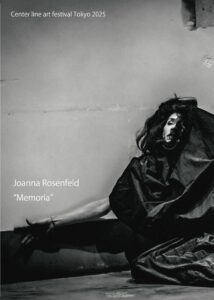
And ClafT1, for example, after the (Memoria) performance, invited me to come back and perform there next year. And that relationship is not happening because I’m exotic, it’s happening because something in what I do is speaking to them, and to the community they represent.
But, you see, I think there’s something about my work that works really well in East Asia ’cause the visual and emotional intensity is contained, in a form that works here. There’s an appreciation of destruction — well, in Germany too. England, maybe not so much. England, they like to make fun of everything. So maybe I’m in the wrong place in England, even though it was my breeding ground.
AW: There’s always that, um, that working-class attitude, isn’t it, in the UK, where they laugh at and make jokes about these kinds of things, the arty-farty stuff.
JR: The working class don’t have access. Here (Japan) it’s slightly different. There’s the pride in the Kabuki, the pride in the sumo wrestling, it’s still very enmeshed with everyone. There is the English class society, and you just cannot ignore it. The working classes were kept away from culture for centuries. So their culture is football, that’s their religion.
Because of the financial division and the shrinking of the middle classes, you have more and more people who are becoming poor in England, and don’t have access to culture. And we don’t see that from here (Japan) because we see England as this privileged place. But there are a lot of people who have no access to culture, who were never on the receiving end of the vicious stealing by the few who benefited from the colonies. We don’t see them, but they’re there.
“…I don’t think this generation is going to mature into consuming theatre,
so we have to change the way we make performance and where we make performance.”
AW: We spoke about AI at some point, I think COVID really accelerated the whole process of digitalisation across many areas of our lives, and it’s also galvanised many artists to engage with that shift. But when it comes to theatre or performance art, I feel like that world has been somewhat left behind, it hasn’t really partaken in the game. The nature of performance art still feels quite analogue to me. Given your long experience in the field, do you think theatre has evolved with the times?
JR: Well, there’re many strands, and some things just are analogue. Procreation is analogue, how we make food is analogue still, with very expensive lab meat the exception. The material nature of human existence isn’t going to go away. Not until we, as a species, disappear.
I think theatre and performance art are about shared experiences. The problem’s not AI, it’s gaming.

AW: As a form of entertainment, you mean?
JR: So theatre used to be our only form of entertainment, and then film came in. We still had shared experiences, but film was kind of a way of creating one performance and selling it to many people — very capitalist, but great idea.
Film and live performance have always coexisted, and then TV came in as a competition. And TV really undermined live performance because you had performers on TV, all the time, doing stuff for you. And it’s filmed, so again, you do one performance and you can repeat it over and over, which reduces the amount of people working in the industry.
Now, I think film and TV, with streaming services as well, have really decimated live performance, even though they’ve all found ways to coexist. What we now have, though, among people maybe 40 and under, is a generation who are not used to watching TV. They’re not used to consuming content in the way that people born in the ’70s were trained to.
So you’re probably used to DVDs, CDs maybe as children. Then later on with Blu-rays, and now streaming services, you’re your own curator of the programs you watch. And then gaming came in, online gaming specifically in the last 20 years, and people don’t even watch TV anymore. They don’t watch films, they’re simply not interested. When they have time off, they go home and get their Xbox out, and play with their friends who might be all over the world. What happens in games is that we have a different way of engaging. TV is becoming boring because it’s singularly consumerist, right? While gaming means I have agency, I have choices to make, and I’m communicating with my friends at the same time. And we see that in performance sometimes these days, when people start eating in the middle or talking to their friends, because we’re now used to the much more relaxed atmosphere of gaming, where you can hear other people having conversations while you’re still playing.
This holy silence of observation is kind of gone for a particular generation. But what I find interesting is that, that generation is still longing for some kind of shared experience. Definitely in Europe, what we see is a huge rise in festival culture in the summer — music festivals, dance festivals, concerts. Glastonbury’s bigger than ever with 250,000 people attending. That’s the same size as Brighton. That’s a big city, for a week, together. That’s a really big shared experience. And people come every year if they can.
There used to be two or three festivals, now there are so many. That’s live performance that we experience together. But in our day-to-day lives, we’re used to something much more interactive. So how do we work with that? I find that really interesting.
Theatre’s kind of almost for old people now, who know how to consume it. And I don’t think this generation is going to mature into consuming theatre, so we have to change the way we make performance and where we make performance.
AW: What do you propose though?
JR: Well, interestingly we just saw this exhibition (The Architecture of Sou Fujimoto: Primordial Future Forest / 藤本壮介の建築:原初・未来・森, 2025, Mori Art Museum), right? I think the problem is about finance, and understanding what theatre does for a community.
The architect we just saw had this one piece that was very open-plan, with a performance space in the centre, seats and seats around it, and these islands above. They seemed unconnected, so people could just wander in, observe for a bit, and leave. I think ultimately that’s what performance has to become — something that’s much more part of our daily experience.
The prediction for humanity is that we’ll have more leisure time and less work time as the automation of labour continues. So we’ll want to entertain ourselves with each other more. That part will not go away. We want to spend time together, focused, dedicated time, exploring culture and experiences together.
But the financing of that has to change. Rather than it being, “Okay, here’s the theatre space and I paid a ticket to be part of it”, as a community, we have to understand that we need to provide it. Maybe as a general tax. Then we know we have a choice to participate, observe, witness, when and if we want to. But we’re part of the creation of that experience, just like we pay taxes for our rubbish to be collected.
I think that’s the only way. It’s similar to what happens with public art now. We create public art spaces, galleries that are sometimes free, and sculptures in public spaces. One of the things I found really interesting about Himeji, when I went there last February, was the public art — it was just out of this world. There were so many beautiful sculptures throughout the streets, as well as interesting 3D works and mosaics. It creates an environment where people are surrounded by art all the time.
And I think performance is the same. We need to understand that it’s part of who we are. Maybe that’s the German in me. Bringing it to where the public is, rather than going, “Oh, you need to come to me.” We, as humans, need stuff to do! We need to find a way of considering what it means to be conscious and alive. That doesn’t mean we’re just taking drugs and destroying things. I think that’s what art is about. That’s my proposition.
Bringing it to where the public is, rather than going, “Oh, you need to come to me.” We, as humans, need stuff to do! We need to find a way of considering what it means to be conscious and alive. That doesn’t mean we’re just taking drugs and destroying things. I think that’s what art is about. That’s my proposition.
I think Tokyo does this, right? I know several Butoh artists who perform in designated public spaces, and there are programmes that licence artists to perform at specific times and engage directly with the public in these spaces.
Footnotes
1. Centre Line Art Festival Tokyo (ClafT) is a multidisciplinary, roving art festival held along Tokyo’s JR Chuo Line. Launched in 2021, it connects artists, audiences, and local communities through exhibitions, performances, workshops, and other programs across the neighbourhoods along the line.
Credits
Editor: Axel Wang
Photography: Courtesy of Joanna Rosenfeld