
I was thrilled to meet Jukan Tateisi (立石従寛) in person for the first time at a co-working space located in the area of Hiroo (広尾), Tokyo, in December 2022. Of course, we had “Zoomed” prior to the meeting, which only further adds to the fact that I personally detest all these virtual meetings — I’m sure a few of you share the exact same sentiment. Let alone all the technical issues you might come across during a Zoom call — the occasional lag, the interruptions, the voices talking over one another — whenever you conduct a Zoom call or a FaceTime or whatnot, it almost feels as if all your energy is being sucked into a black hole, in return, you collect nothing whatsoever from the other end of this black hole, except plain words and just, sound. Then there’s that uniquely post-modern awkwardness of waving goodbye on a video call while your eyes dart frantically across the screen looking for the “End Call” button, hoping the other person doesn’t notice.
Call me analogue, but I was genuinely glad that we could finally, actually interact with each other in real life again.
Rants aside, another reason why I was thrilled, was because I was once again setting foot in the city of Tokyo, after an absence of almost three years, primarily due to the pandemic. The city felt similar, the crowd felt similar, and the same went for everything else in Tokyo, everything felt similar to what it once was, as if the pandemic had never occurred. I was able to feel invisible. There was a sense that, I could do whatever I wanted, adhering to the unspoken social etiquette, it goes without saying, within the abdomen of this gigantic monster of a city.
Jukan Tateisi, the artist, splits his time working between Tokyo and Karuizawa, a premier holiday destination known as Tokyo’s back garden. I cannot deny that Jukan’s background played a role in catching my attention from the very beginning. Born in Chicago, raised across Japan, Toronto and apparently Amsterdam too, the boy had already traversed a large part of the world at a young age. Born into a family that owns one of the major companies in Japan (out of respect for the artist, the name of the company will not be mentioned), his life seemed to have been all planned out for him. Yet it wasn’t the path that he chose. Be it rebellious or otherwise, Jukan took his steps in taking on perhaps one of the most challenging, and arguably the most unreasonable and unorthodox occupations on this planet: becoming an artist. Boy oh boy, I can’t even start to fathom how many fights and arguments must have gone down when this was first brought up within the household.
Nonetheless, he did it, I don’t know how, but he did. With a background in System Design and Management — I’m guessing that had something to do with computers — he packed his bag, brought his family on board, and arrived in London, enrolled at the Royal College of Art for his second master’s degree, this time in Fine Art Photography. From that point onwards, the guy never looked back.
Coming back to Japan right when the pandemic struck, Jukan has since won awards, co-founded a couple of galleries, participated in numerous projects and worked with some of the biggest names in the industry. Becoming an artist no longer seems like the most ridiculous decision in the world now, does it?
During our two-part conversation, Jukan and I discussed his past and how his experiences beyond the borders of Japan have shaped him both as a person and as an artist. We also touched upon the AI-related aspects of his work, given the technology’s exponential rise in significance in recent years. In the second part of the interview, we focused our attention on his work after returning to Japan when the pandemic broke out.
The Artist’s Journey

AXEL WANG:
It’s just me being nosy, Tateisi-san, and maybe this is just standard practice, but why did you have the “H” removed from your surname in Romaji?
JUKAN TATEISI:
You are the first person who has brought this up. (laughs) As you know, normally in Japanese the “Shi” sound is spelt with an “H” in Romaji. The story goes back to my grandfather, who was an engineer and businessman, and as you probably know too, he launched a major electronics company back in the Showa days.
My grandfather was someone who was always looking to innovate, with almost everything. He used to publish papers internationally, and noticed that there were other people who shared the same surname “Tateishi’, and that’s when he decided to set himself apart and differentiate himself, by removing the “H” in his family name.
Throughout my life, I had to make decisions like everyone else, one of them being whether I should take over my grandfather’s company. In the modern era, I believe it’s not really about whether I’m a family member or not, it’s more about the individual, meaning there’s no guarantee that I’m just going to be the CEO unconditionally.

AW: It’s less about blood and more about the ability and skills of the person.
JT: It goes without saying that I do have great love, respect and gratitude towards the company, the employees, clients and consumers, but in the end, I decided not to be a part of the company simply because my passion lies somewhere else. After graduating from the Royal College of Art (RCA), I adopted “Jukan Tateisi” as my artist name with the “H” removed. I guess that’s my way of inheriting the concept and ideology from my grandfather since I was no longer with the company.

AW: We know that you were born in Chicago. During our first meeting, you said that because of your father’s job, you had to bounce around between Toronto, Japan and Amsterdam, when you were young. What was it like growing up among so many countries and cultures as a kid? It must have been crazily overwhelming.
JT: Yes, for sure, but when you look around Europe, there are tons of people with various backgrounds, so I’m definitely not the first. I came back to Japan for the first time when I was five, I don’t have many recollections of that period of my life, but my mother told me that I struggled quite a bit, especially whgen it came to communicating with the other kids, and that I seemed happier whenever I was out of Japan, mainly due to the way I expressed myself, like through writings or drawings you know. Thinking about it now, I imagine it’s because growing up in Chicago, for example, I experienced mostly snow and wind, it’s not like that in Tokyo. That’s probably what created these gaps and disparities between the rest of the kids and me, because we had different childhoods.


AW: Do you think that your background and overseas experience particularly influence your style of work?
JT: To a certain extent, I guess, yeah. This is something that I consider a lot actually, my identity as a Japanese with a slightly different background, and how this background affects the output of my work artistically and aesthetically. I’ve been training myself in Japanese tea ceremony and calligraphy, and you would probably find a lot of references to concepts derived from these traditional Japanese rituals or practices in my work, and in how the work is installed and presented — the lighting, the sound, even the temperature of the space.
A straightforward, but impactful concept from the tea ceremony, for example, is that, when there’s a heavy object in question, like an iron box, you would present it in an “airy” way, by tweaking the height, say, of where this box is situated. By contrast, if the work is light in weight, like a print, you may exhibit it as if it’s denser, more compact, even more suffocating if you wanna go a bit wild, by incorporating shadow, for instance. The viewing experience and how you perceive the work would be hugely different.


AW: I would like to fast-forward to the time just before you moved to London. You were working for your family’s company before the move, and you also told me that you had a newborn at that time. Moving to another country on the other end of the world, I hope there weren’t any arguments within the household.
JT: Of course, there were. (laughs)
AW: But why London, why art?
JT: The first so-called artwork that I created was a piece of music when I was 16, as far as I can remember. Around that time, it was still fairly difficult for me to communicate with people here in Japan, not only verbally, but once again, it was more like a difference in mindset. I guess after a while of navigating, it became clear to me that, in fact, visual or sound-based communication was rather effective. I think that was the very initial trigger. It wasn’t as though I had already set out to become an artist, rather, it was a more appropriate way for me to umm, survive, metaphorically speaking, in Japanese society.
Before I enrolled at the Royal College of Art, there was a period of around 10 years, for me to find out who I really was, a testing period if I could put it that way — to see if I should be a part of my grandfather’s company, if I could become an entrepreneur, engineer, venture capitalist or whatnot. I was almost avoiding working on art. In the end however, I just came to the conclusion that art was the only thing that clicked for me after that testing period. Therefore it wasn’t exactly an instantaneous or spontaneous decision: “Ah, I’m just gonna do art”, but more like, “At last, I get to do art.”

AW: A lot of your works and projects consist of the element of sound. Voyage in Sound (2016), for example, it’s practically a work of sound. What does this medium of “sound” mean to you?
JT: When we talk about emotions and the five senses, for me, the act of seeing is our way of verifying our surroundings, the environment — our sight confirms our world; when you touch something, that relates to ontology, like self-assuring, corroborating the fact that no immediate danger exists; whereas hearing, the auditory process for me, is to establish somewhat of a connection with and within myself — our hearings confirm ourselves. For me as an artist, in order to project myself to the world, I must create that connection within myself first and foremost.
AW: You dwell in a variety of media, not only sound and music but also photography, installation and so on. Where does your love for multimedia come from?
JT: Honestly, I don’t know. I just think it’s fun because I enjoy playing around with concepts and materialising them, whatever medium it is. Around the sixties, there was the ZERO movement1, Yves Klein2 created the fire paintings – the fire took over the paintbrushes. We’ve also seen needles being used instead of brushes or canvas or whatever. The end product, the final output of the artistic process, was eventually, a painting on a canvas — regardless of the shape of the canvas — created by human artists.
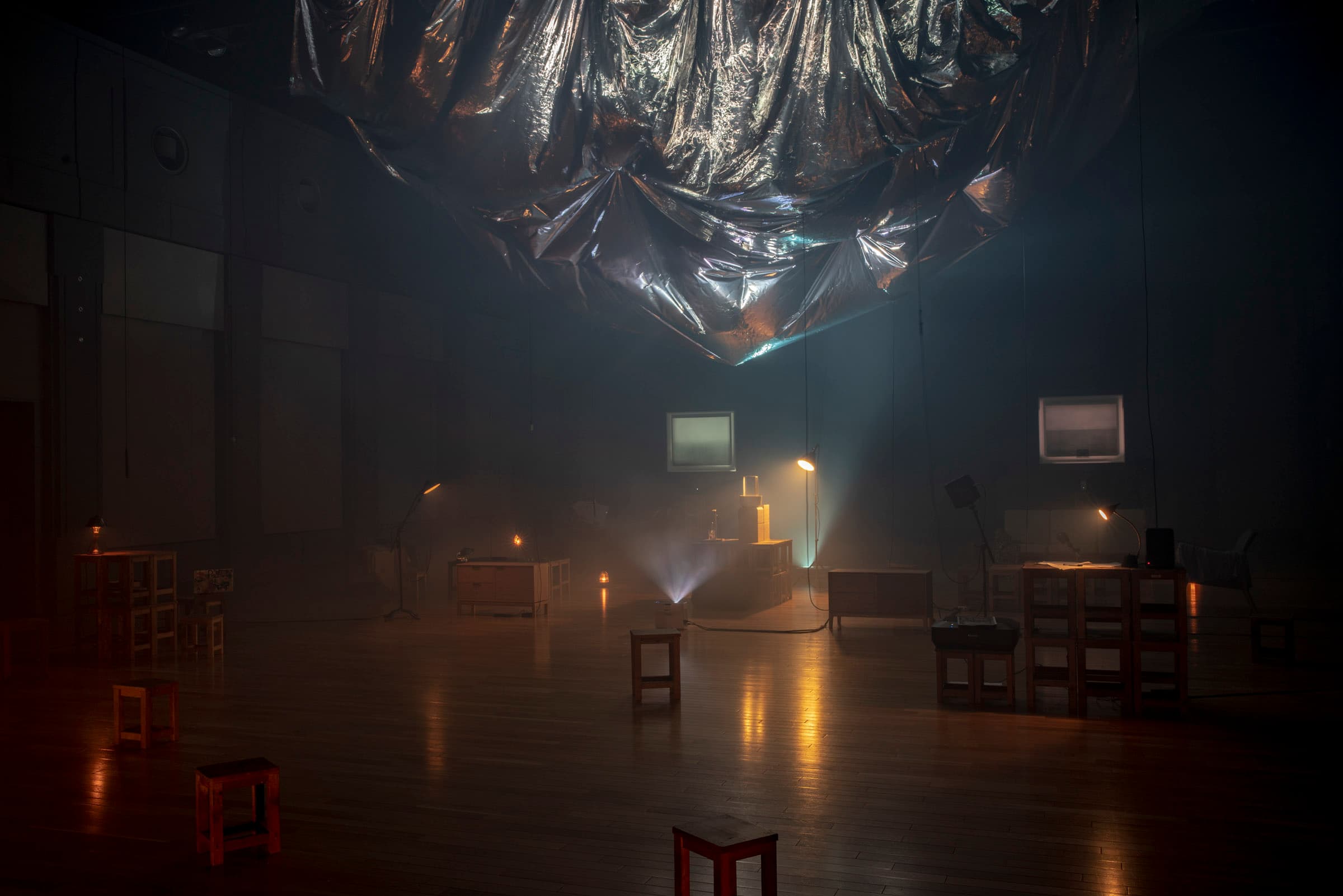
Whenever I think of painting, the idea of a painting is constructed by the components of a canvas or paper; some sort of support for the canvas; plus paint or ink; together with the painter himself or herself. Obviously, we can add space and value to that list of components, but they are probably beside the point here. The recent work that I created, A Study of In(to)stallation (2022), was probably my experiment in tweaking, or altering, these components of a painting and the underlying relationship between them.
Embarking from the mountain forest — that’s the canvas; the living and growing trees act as supports for the canvas; the rain, the wind, and the bird droppings even, they all contribute to the actual painting process. Since the work is an installation that viewers can actually step into, the concept of this installation began with all the aforementioned components of a painting, so I guess I’m also kind of asking the question: can we still call this work a painting here?
Take Sol Lewitt3 for another example, he provided instructions for his paintings when he exhibited them. The painter could be anyone, so the actual painter was absent or void. The instructions could perhaps be perceived as the rule of the painting or the painter instead.
When we look at the history of painting, these days the thought process behind a painting is gradually shifting away from that course and more towards Artificial Intelligence (AI). The whole structure has become highly randomised — the painter turns into AI, there’s an algorithm, though that algorithm is created by humans or artists, and simultaneously, these algorithms can be shared among artists. The components can become very complex, and it’s definitely something that I wanted to explore further.

AW: Speaking of AI, in 2017, you created Expose and Hide, an augmented reality (AR) virtual exhibition, if I worded it correctly, before your time at RCA. It’s widely adopted nowadays apparently, but back then it wasn’t that prevalent. I unfortunately didn’t get to see your exhibition in person, but do you think you could share some thought processes behind the project?
JT: I think I’ve always been curious about the boundary between the two worlds — the science/technology world, and the art world, even when I was at my family’s company. The concept of the project was about how our memories are structured through recorded information that is co-shared with other people. Like Dropbox, for instance, the data is created as a kind of commonality shared among users who have access to it, it’s like we all get to share a bunch of memories on the cloud together as part of the collective data set.
Another layer is that, I think many of us, find it easier to expose more of ourselves on the internet, in a digital or virtual world, say on social media; physical interactions, expressions, or communications, on the other hand, can be somewhat difficult for certain people, so we tend to hide behind a protective veil instead, in real life. In the exhibition, actual prints of the portraits were exhibited in the physical space, but if you examine the works via a device, the augmented reality exposes more of the subjects, almost nude, hence the title.


AW: In It Is What It Is (2017) and Another Seascapes (2019), you experimented further with AI. In today’s art world, there’s a certain feeling that everything has already been done. Nonetheless, as technology advances, I think it’s inevitable that artists or we humans in general, feel that AI has to be the next step. The most discussed question is perhaps whether AI is going to replace humans in the end. How do you envision this relationship between AI and humans yourself?
JT: I guess AI will be hidden away. It will exist for sure, like everywhere, ubiquitous, and we won’t even notice that AI is AI anymore. We won’t feel that it’s scary, nobody recognises it as a danger.
AW: It’s just there, like a tree.
JT: It will probably be something very close to the concept of bacteria which live within us.
AW: A bit like COVID nowadays then.
JT: That’s actually a good way of describing it. On the other hand, when you said that many are worried that AI will jeopardise humanity, for me, that’s not really possible, at least for the foreseeable future, because we humans possess other qualities like emotional and physical intelligence, for example, I don’t think AI is able to replicate that just yet. Some jobs based on rules, manuals, or algorithms, like the banking systems or lawyers even, may possibly be replaced by AI in the future, but for me, the bigger question lies in whether AI can come up with its own rules one day.
When AI defeated the human Go world champion Ke Jie4 in 2016 or 2017, people were literally screaming, that this must be the end of the human race. Yoshiharu Habu-san5 proposed that perhaps we could change one rule in Shogi, like how the knight could move, for example. By changing one simple rule, there will be a time gap between the AI actually studying the rule and making the calculation, but humans are able to adapt to the rule immediately. Therefore, so far it seems, that the ability and right to rewrite rules, still belongs to humans.

Footnotes
1. ZERO was a Düsseldorf-based artist group established in the late 1950s by Heinz Mack and Otto Piene. Piene referred to it as a “zone of silence and pure possibilities for a new beginning.” In the 1960s, ZERO evolved into an international movement, attracting artists from Germany, the Netherlands, Belgium, France, Switzerland, and Italy.
2. Yves Klein was a French artist who pioneered the monochromatic painting style. His “fire paintings” are a series of works created by igniting a mixture of solvents, pigments, and gas on a large metal or paper support, producing a one-of-a-kind burst of colour and flame. The resulting charred surfaces are considered by some to be a testament to Klein’s ideas about the human experience of the void and the pursuit of transcendence. These works are regarded as important examples of his contribution to the development of performance art and its continuation by later artists.
3. Sol LeWitt was an American artist and a leading figure in the Conceptual Art movement, best known for his large-scale wall drawings and structures, which were executed according to written instructions that he provided. These instructions were often simple, precise, and numerical, leaving the final execution of the work to others, sometimes professional draftsmen or volunteers.
4. Ke Jie (柯洁) is a Chinese professional Go player widely regarded as one of the strongest of his generation. He became a world champion multiple times and gained international attention for his matches against AI systems developed during the rise of machine learning in Go.
5. Yoshiharu Habu (羽生善治) is a professional shogi player from Japan. He has won numerous titles and is considered one of the greatest shogi players of all time. Shogi is a Japanese chess-like game and one of the most popular board games in Japan.
Credits
Editor: Axel Wang
Photography: Courtesy of the artist