
How High We Go in the Dark

AXEL WANG:
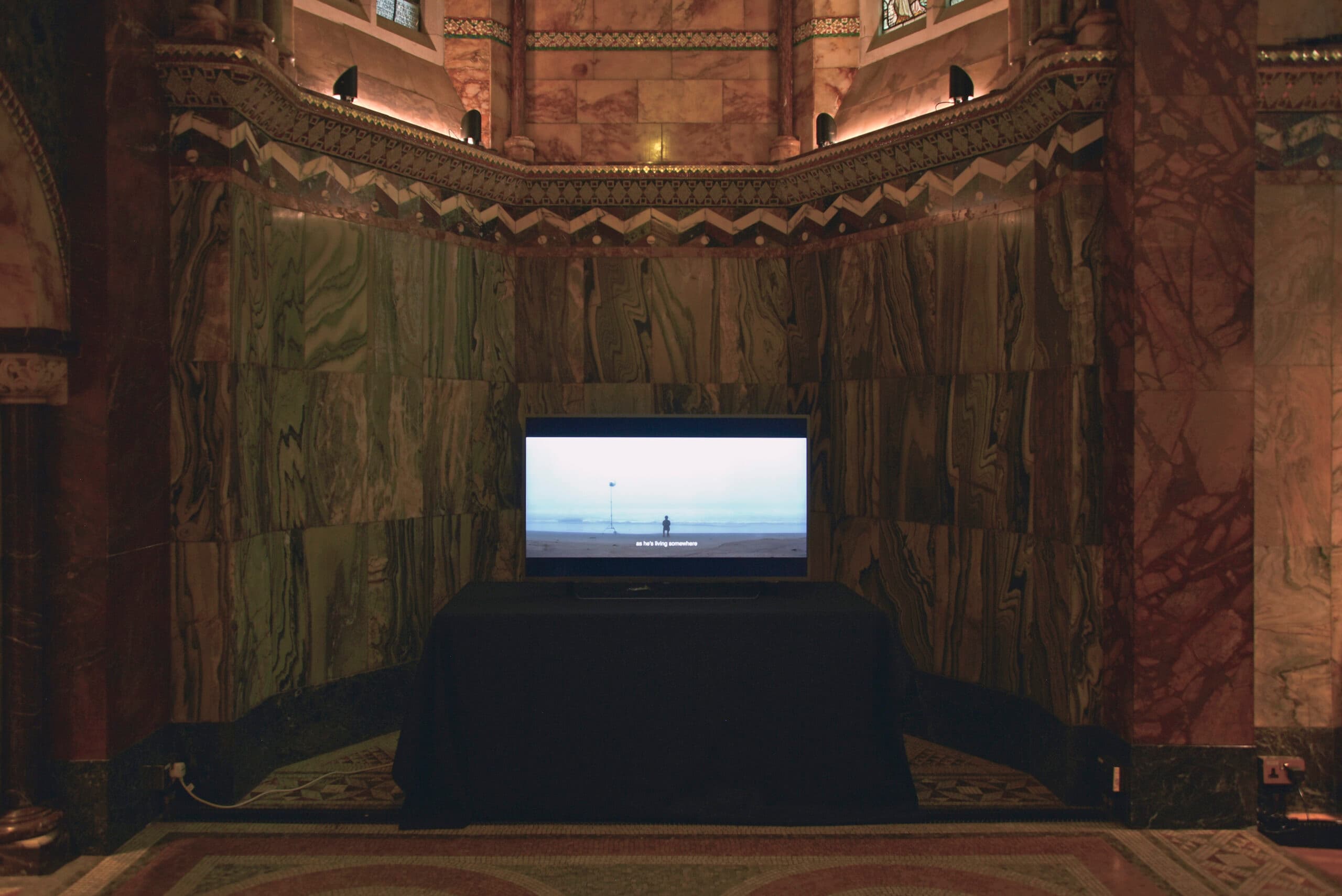
Entering 2020, it felt like the human race was introduced to a new era because of the pandemic. I was watching To the Fog (2020), and I was thoroughly moved. It was a very simple idea executed supremely well. I sense sorrow and perhaps regret from your monologue. The uncertainty that you experienced at the time, on the other hand, somehow carried a glimpse of a silver lining beyond this reality that you were trying to demonstrate. Can you provide some insights into the production behind the work, why did you pick that location to shoot?
JUKAN TATEISI:
Thank you for the kind words. The piece was shot in June 2020, on a southern beach in Kushiro (釧路), Hokkaido (北海道). I went for that place purely for practical and realistic reasons, because of the season, the allocated shooting time, and, of course, the budget and everything. During summertime, particularly in Japan, fog mostly occurs in the mountains, so there weren’t actually that many options for me. Also, because it was during the lockdown period, I was only able to manage three days in total to shoot everything, the beach at Kushiro just happened to tick all the boxes.


AW: Why fog specifically?
JT: It was from the moment that I entered my grandfather’s company… that I began to put a lot of thought into ecology in its broadest terms, the system of our society, and the relationship between artefacts, humans and nature. The idea behind that project was unquestionably evolving around COVID and nature, nevertheless, in reality, the idea of fog itself first arrived to me in 2016 or 2017, I think.
I guess it’s all to do with my life experience, coming to think of it. During that same period of time, I came across Fujiko Nakaya’s1 work in London, she’s known for her fog sculptures, and that was the first time I experienced her work in person, and I was very much inspired.
When I was little, while I was in Chicago or Toronto, there were blizzards all the time during winter, as far as my memory goes. Fog also occurred in Amsterdam quite often, and I used to see it almost every day. London can be very foggy at times too… So yeah, somehow fog just became a massive part of my upbringing. Somewhere deep in my memory, I was always reminded of the bloody sunset or the sunshine in the morning piercing through the clouds when the fog cleared, then I experienced Nakaya-san’s work, it’s like all these memories of the past all mashed up and just dwindled down into one place.
AW: Like while you were situated inside the fog, you kind of lose track of time.
JT: Precisely. As a result of the Expose and Hide (2017) project and some other AI works that I did, I was drawn towards this relationship between the existence of our physical bodies and our minds in the virtual world, for instance, social media. Instead of individuality, it’s more about dividuality2, like how several dividualities compose an individuality.
When we use social media platforms, especially Twitter — nowadays the algorithm of Twitter has totally changed, but back in 2016 or 2017, a viral tweet that we saw then was not necessarily created at that particular moment in time, it was probably first tweeted five years earlier or something like that. I found that in a virtual space, we lose track of the actual timeline and actual reality, you lose your idea of time in a geographical sense, as if everything ends up in a spaghetti situation in the virtual world, the sense and scale of time no longer exist, just like when I experienced the fog.


AW: Beach on Beach (2022), is there any sense of a continuation from To the Fog (2020)?
JT: Yes! In 2020 when COVID happened, a lot of discussions were centred around nature, virus, society and so on. I thought that was the right moment for me as an artist to pay more attention to nature itself, to how much we have actually changed the natural landscape.
To the Fog (2022) was more about the vertical axis, as if we break down the world into numerous connected chunks of small cubes of space, like there’s an invisible wall placed right in front of us, separating us from what’s afar. Beach on Beach (2022), on the other hand, it was more horizontal…

AW: What did you mean by the natural landscape being changed?
JT: It was in reference to Anthropocene3 — it’s been quite a vital term over the last maybe 5 to 10 years in the art and philosophical world. In 2020, due to COVID, more people in Japan became aware of this term or epoch. The idea behind Anthropocene is very simply, that nature is no longer natural, nature is in fact, artificial, as a consequence of constant human intervention.
The same goes for beaches, they always get washed up, and human intervention takes place there all the time. We can neither confirm, nor see, nor feel the traces of history and memory within the landscape, so I wanted to visualise that by shifting the horizon upwards and creating a superimposition, like a utopia free from everything.

AW: Since it’s a public installation artwork, how did the public react?
JT: It was amusing, actually. The work was located at Katsuura (勝浦) Beach in Chiba (千葉), it’s known as a family beach with parents and kids running around, lots of couples etc. I was eavesdropping (laughs), and overheard the conversations between kids and fathers, where the fathers would say stuff like, it must be a stage for some music festival, but then the kids would just become very curious because they didn’t see any stage props or anything, so they would run around the work, go underneath it and climb on top of it, I think the work turned into a household gadget for the families and it was nothing to do with contemporary art for them (laughs), which was delightful to watch, I loved it.

AW: Dive Into the Mirage (2022), it was your solo exhibition in the 5th Floor Gallery, right?
JT: It was actually held at TOH Gallery, near Yoyogi, Tokyo. I founded them both back in 2020, though I’m not involved in the day-to-day anymore.

AW: The exhibition consisted of several pieces of your works, and the installation that took centre stage was titled Between A and/or B (2022). Can you tell us a bit about this work?
JT: Through the direction and the production of To the Fog (2020), I wanted to explore more about ambiguity and fog. Despite the fact that the COVID situation was improving in 2022, there was an unequivocal apprehension that the entire world remained overshadowed by ambiguity.
One key term that kept occurring to me was, “動的平衡(どうてきへいこう)” — dynamic equilibrium4. It’s a term that you would normally come across in chemistry, in the sense that I felt that the world surrounding us had already begun to move around dynamically, even though it was moving at a relatively cautious pace. There was a certain feeling of a balance in place somewhere, nonetheless, that balance was not static, it was constantly shifting towards a different direction.
A bit like our minds, even though we are situated in the present, the mind shifts towards the past and to the future, or somewhere unknown. Our minds are forever shifting between everywhere and anywhere.
Another thing that I found particularly fun about this exhibition was that, during the exhibition, visitors could hop on the swing, but due to building regulations, the swing itself was not anchored to the floor, inevitably causing the visitors to feel anxious while they were on it. It wasn’t something that I took into consideration honestly, but I thought the whole experience became quite interesting learning the visitors’ reaction because, in addition to the swing, the space was recorded using a microphone at all times.
Anyone could swing, they could sing or make whatever noise they wanted, and a playback of the recorded sound would be looped throughout the exhibition period. It sounded a bit like amplified chanting or prayer — I incorporated the element of fog as well — the whole thing almost turned into a sacred space.

AW: In some of your works, I sensed a bit of defiance, in Archipelago in Transition, or Echo-World (2022), for example, that you were also responding to societal, cultural or even political affairs, which is relatively uncommon in this country. Is there a message that you are trying to send, or am I reading too much into them?
JT: The message would be… Everyone should enjoy art because it’s super cool, so let’s have some fun. (laughs) Jokes aside, it depends on the work, but yes, I do think artists carry such responsibility, be it large or small.
In Archipelago (2022), I wanted to remind people of the fact that country borders are literally human constructs which haven’t existed for that long if we place them within a larger context; In(to)stallation (2022) is more or less about how and where art can be viewed, especially in Japan, to summarise it briefly; whereas Beach on Beach (2022) is for viewers, myself included, to reconsider and to re-evaluate our relationship with nature.
I believe that there should be one triangle connecting the artist, the audience and society. If my work doesn’t transmit to the audience or to society…
AW: It would be like masturbation.
JT: Yeah… If it fails to achieve that, I may have some difficulties referring to this particular piece of work, as a work of art.

AW: 2022 has been a very productive year for you. What have you got next?
JT: Both Beach on Beach (2022) and In(to)stallation (2022) are very unique projects for me personally, and I would love to continue them globally. When I was working by the beach, I realised that the beach can be extremely multifaceted. If you drive along for only about 2 minutes, the scenery gently morphs into something else, because of human intervention once again.
I would love to take the project to say, southern Spain or Bali, somewhere resort-like, I guess that can also act as a trigger for people to think twice about the idea of resorts, about human intervention, and about the severe environmental effects they cause.
In(to)stallation (2022) was installed in Karuizawa (軽井沢), Nagano (長野), where I currently live. I go to that mountain where the work is situated, probably once every three or four days, for archival purposes. Many people may think that mountains are static, but in fact, they are perpetually changing and reinventing themselves due to seasonality.
I’ve been contemplating the execution of this existing concept elsewhere, what if it’s on a different mountain, what’s going to happen to the material that I used, what about the scale, even its shape and so on.
AW: By the way, I checked out this podcast that you’ve been doing, having so many things going on, your schedule must be crazy, so thank you so much once more for doing this interview with me.
JT: Thank you for having me. In fact, so far, the podcast doesn’t demand that much effort, not much research or anything is required before each recording session. We kind of just improvise, it’s all very casual. I guess it’s just another medium that I’m trying to express myself through. It’s just like us talking, sometimes it sparks something else, but man, there are so many podcasts these days. (laughs)

Footnotes
1. Fujiko Nakaya (中谷芙二子) is a Japanese artist known for her large-scale installations of fog. She creates immersive environments by using machines to produce fine mists of water vapour that interact with natural light and the surrounding environment. Nakaya’s work is often inspired by her background in science and technology, and her installations have been featured in a variety of public spaces and exhibitions around the world.
2. Deleuze’s theory of difference, or “dividualism,” is a concept in philosophy that challenges traditional notions of individualism and subjectivity. According to Deleuze, the idea of the individual as a fixed and stable entity is misguided; instead, he posits that the self is composed of a constantly changing flow of differences and relationships. The concept of dividualism has also been proposed by Keiichiro Hirano (平野啓一郎).
3. The Anthropocene is a proposed geological epoch that recognises the significant impact that human activity has had on the Earth’s environment and ecosystems. The term was first used in the 1980s to describe changes to the planet resulting from human activities such as deforestation, urbanisation, and greenhouse gas emissions.
4. Dynamic equilibrium is a concept that refers to the balance between opposing forces or processes within an ecosystem or biological system. It describes a state in which processes that create change are balanced by others that counteract or stabilise that change. As a result, the system remains relatively stable over time, despite fluctuations in individual components.
Credits
Editor: Axel Wang
Photography: Courtesy of the artist