
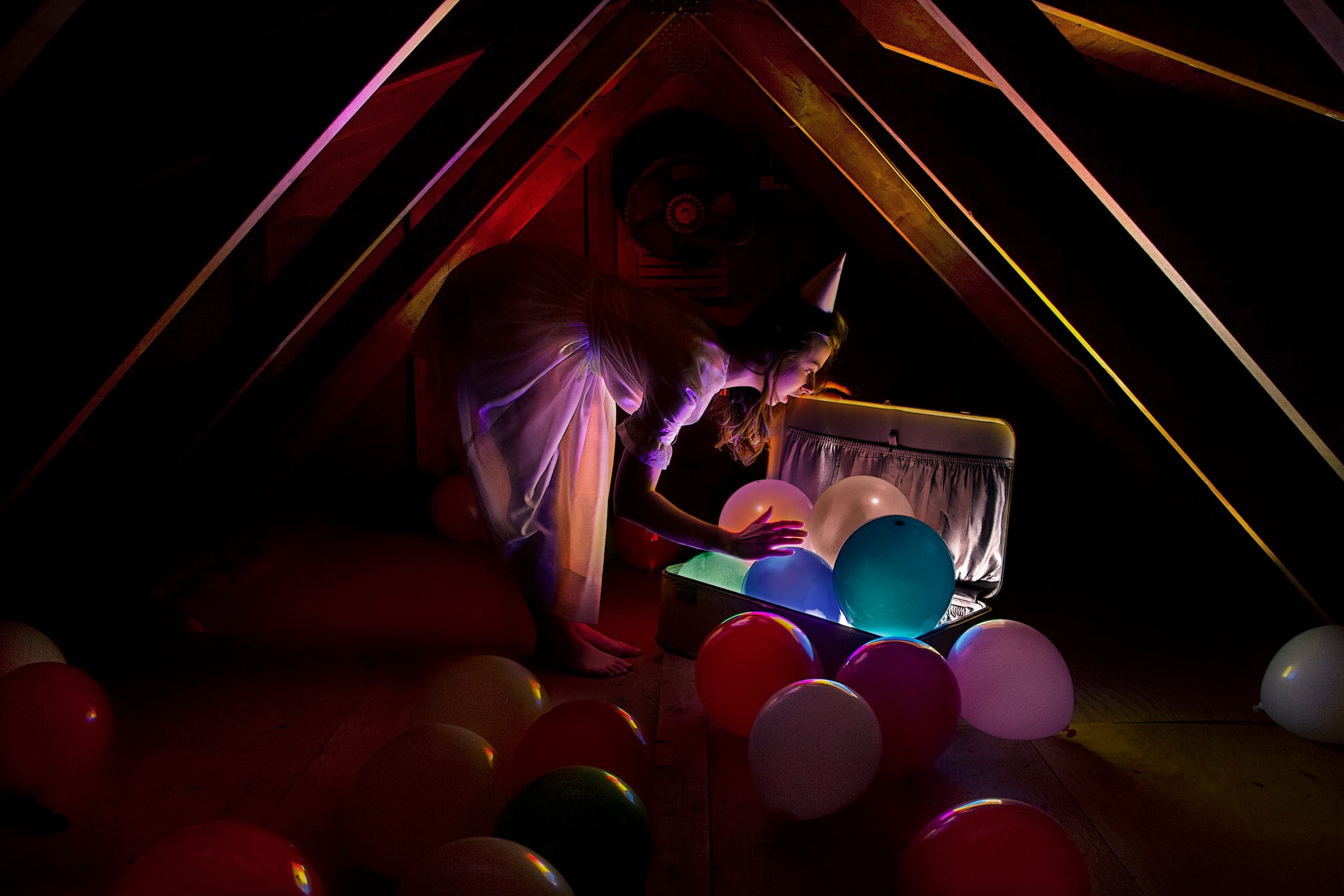
We conducted an interview with Loreal Prystaj, a second-generation Ukrainian immigrant born and bred in the US. The artist is currently based in London.
Loreal’s artistic practice explores realms of consciousness, storytelling, and mysticism using a diverse range of media such as photography, moving image, sculpture, and sound. Drawing inspiration from psychoanalysis, archetypal symbolism, and surrealism, her work accentuates the psychological impact of the environment on both individuals and collectives. Engaging in a continuous conversation between the internal and the external, Loreal invites viewers to introspect on their consciousness and contemplate their influence on the shaping of their surroundings.
As I sat down with Loreal, our dialogue unfolded across four separate, yet interwoven chapters. In this initial segment, Loreal revisited her childhood and upbringing in suburban New York, recounting her formative years at the Fashion Institute of Technology (FIT), and elucidating the motivations behind pursuing advanced studies in London. The second chapter illuminates Loreal’s artistic residencies across various global locales, including Japan and Finland, alongside the unexpected chain of events that led to her enrolment at the Royal Academy of Arts.
From there, in the third instalment, the discussion turned towards the mishap that befell her work Body Farm (2020) and her experiences of building a life in London, a city she now calls home. We also touched upon her first trip to her family’s homeland, Ukraine, bringing forth a poignant exploration of familial bonds and heritage, before naturally giving way to a conversation about the evolving contours of her relationship with her mother.
The interview took a reflective turn in the concluding fourth chapter, where we discussed the transformative journey of Loreal’s artistic practice over the years.
The American Dream
AXEL WANG
First of all, it’s great to see you (on Zoom) again, Loreal. I wish we could have done this under slightly better circumstances, you know, with us winning the open call and conducting the interview face to face when you come to Japan. Once again, that’s life, I guess.
LOREA PRYSTAJ
There’ll be more opportunities to come, I have no doubt. Also, as I mentioned previously, I still plan and hope to be in Japan very soon. So I will let you know when that happens!


AW: May I just ask first, where are you right now, and what have you been up to lately?
LP: I just returned to London. I was just in Denmark for an exhibition and talk last week, it was the final phase of a collaboration that I was part of with the Danish artist Christel Elver Pilkær. And it was a wonderful experience! This collaboration started back in May 2023, and I had been going to Denmark since May till September — almost every month working on two different projects. One was a public sculptural art piece out in the woods called, Urds Brønd (2023), which is a Danish phrase meaning “the Well of Life”. The work reimagines different narratives from Norse mythology, and how a lot of these stories, within Nordic folklore, are depicted as deities, spirits, or even ghosts that exist within nature.
Last week we expanded upon the piece Urds Brønd and continued our collaboration in a gallery setting, encompassing photography, installation and sound — we created a space where people could step into, a sort of, “liminal space” infused with all these stories and rich narratives. We were thinking about this term, “liminal space”, and where it exists in our day-to-day life.


While contemplating, we thought about the experience of transitioning from wakefulness to slumber and entering the subconscious, bearing in mind the symbolism found in water and nature relating to the subconscious. The installation was constructed out of cyanotype on raw cotton and bedsheets, hanging from the ceiling. People could walk between the suspended pieces, as if navigating through a blue underwater forest, entering a portal, leading to a new reality — like falling asleep into a dream, furthering the concept that these stories and narratives found in folklore or mythology, are still being carried out in today’s world, perhaps buried and forgotten, but never lost. It’s about resurfacing these narratives.
Our bodies, like nature, serve as archives of memories and stories. The work aims to draw parallels between the body and nature, and how these stories and spirits can be brought to life when we shine a light on them in the contemporary world as well.
AW: I was going to ask about this project towards the end of our interview, but it seems you’ve already provided the perfect answer. Now let’s go all the way back! You were born in Fairport, New York, some call it a town and some call it a village, does your family still live there?
LP: My parents still have the house, but aren’t living there physically, however. They moved to Texas, and the house is currently full of boxes everywhere. So, my childhood home in Fairport… yes, I still have access to the house, but it’s not the home that I grew up in.
AW: From the map, Fairport looks like one of those very remote American towns that you often see depicted on American TV.
LP: It’s American suburbia, like in American Beauty (1999), where you see houses next to each other, all the lawns are neatly cut with white picket fences. I mean, granted, we didn’t have a fence, but they exist.

AW: In those places, it’s like everyone just knows everyone else, with lots of murders and supernatural stuff going on.
LP: For real, Axel. I’m not a huge fan of American suburbia in the sense of living there because of what you’re describing. You know, of course, even though in films they are romanticising or dramatising these certain scenarios, there is some truth in that. I think the homogeneity of the lifestyle and this kind of domestication contribute to… I mean, I don’t want to get all morbid or anything, but I knew of a couple of people who took their lives… there are things that go on behind closed doors, but the presentation is always pretty.

AW: What was it like for you, growing up in that small, enclosed, domesticated environment? Especially with your name, I thought you had a relatively peculiar surname, and sharing the same first name as the shampoo, would you say you have fond memories of Fairport, or you are more like, I’m not stepping back there again?
LP: Interesting question. Well, first about my name. My dad is Ukrainian, despite being born in Munich, Germany. That was solely because it was right after World War II, a time when people were shifting countries like moving puzzle pieces — he was in Munich with my Baba and Gigi (grandparents), until they moved to
Brooklyn, New York.
I don’t recall if I shared this with you, Axel, but I was originally going to be named Zoya, which is a Ukrainian name. But in the end, both of my parents just loved the sound of the cosmetic L’Oréal, (French: [l‿ɔʁe.al]), so that’s that!
My upbringing is definitely a bit of a dichotomy. I have a lot of fond memories, shared with friends and siblings, that I could go into loads of detail about the many spontaneous things that we did to entertain ourselves in a small town, very mischievous! Dare I say, on the household front, also fond memories, and also, umm… it’s quite a trajectory of stories that would unravel a lot in this conversation.
Before I was born, my mom was an art teacher at an elementary school. As she described it, making “peanuts”, like no money at all. Since she also has a mathematical mind, she went and started a course in engineering, and lo and behold, my dad was her teacher, who at the time, was going through a divorce. He had two daughters with his first wife, my half-sisters — though I see all my siblings as family. I’m one of five kids… without going into too much detail, when I was born into the family as the youngest, I witnessed certain tensions within the household that had started long before I entered the picture.

AW: It does start to sound like one of those American TV series!
LP: I know! Mind you, firstly, my parents are only three years apart, and simply grew attracted to each other. At the time, my dad was going through a tough divorce with his first wife, who, if I recall correctly, had substance abuse issues. One day, when my dad was very stressed, my mom helped him with organising assignments and paperwork. As a kind gesture, he asked if he could buy her a drink, or something like that. They grabbed a drink, and the rest is history. I recall my dad sharing with me that there was a student who always handed in such perfectly drawn engineering diagrams, that he was continually impressed by — it turned out to be my mom’s assignments. You know, I perceive him as an artist at heart as well.
AW: I was going to ask if you come from a family of artists.
LP: My dad pursued an engineering career, but at heart, I believe he is 100% an artist. When he was younger, he wanted to be a cartoonist, and he also had a full ride to go to the Rhode Island School of Design to study illustration. However, coming from Ukraine, and moving to America, the American dream kicks in, to make money, get a house, start a business, “make it” — all that kind of stuff.
And when my grandparents, his parents, found out that he had been offered this opportunity, my Gigi, his dad, asked the professor, ” What would my son do with his life? How will he make a living?” And the professor responded that he could become a cartoonist. Gigi was like, ” Nope, my son is not going to be a cartoonist,” and just pulled him out of receiving the scholarship. So my dad’s dream of becoming an artist was swept under the carpet.


AW: Let’s put the spotlight back on you. Although your mother was an art teacher, did you always know that you wanted to become an artist, even before enrolling at the FIT?
LP: That’s also an interesting question because when I was a child, I was making art all the time — drawing, sketching, and sculpting with mud. I don’t ever think it was a feeling of wanting or desiring, it was simply coming through me; my Being. And of course, when I hit early teen years, I was influenced by my surroundings more — by friends, family, my siblings, and I was investing my time and energy into other things like sports, drama — it’s not that I didn’t enjoy those things, but I don’t think they were my truest essence.
Not until I entered high school, I took a darkroom photography class and was in multiple art classes; suddenly, I felt I was being reacquainted with “myself”. That’s when the more conscious thought, “Yes! I want to be an artist!” and “This is who I am”, began to take root in my decision-making. I think that artistic mindset was already within my hardwiring of my essence, since I was a little kid.
You know, as children, we have this profound ability to just be, where no conditioning or veils are covering our pure and authentic selves. No influences or expectations are sinking in quite yet, you just are. Simply being… and then these veils are put upon you as you age, telling you how to be, what to be, how you should think, or what to do, and then at some point, you may become conscious that you’re being influenced by things that aren’t truly you, and you have to peel those layers off — one veil after another to remember who you are.


Before I enrolled at FIT, I perceived that the direction best for me was fashion, which was the reason why I moved to Manhattan to attend that university. I loved the experience in many aspects — a university focused on the commercial world, located in New York City, taught me to think really quickly, and to execute ideas that could catch people’s attention — being influenced by the fashion and commercial world, I was taught to “sell” a picture in a couple of seconds, not tell the story behind it. The focus was solely on colour and composition, two very important aspects, but that kind of outlet for creativity resulted in feeling a bit empty for me. I started to acknowledge that I wanted to dive into fine art and a more conceptual artistic direction, rather than going further into fashion or the commercial world.


AW: That’s why you decided to pursue an M.A. in photography afterwards.
LP: After I graduated, I felt such an energy infused from the experience; from life itself, from that acknowledgement of what felt true for my artistic pursuit. Oh my gosh, looking back, it was wild. Straight after my undergrad, I was like a nomad for a year, with my backpack, living on people’s couches. At the time, I was making my bathtub series, because that’s what I had access to — everyone had a bathtub — taking photos in people’s apartments, and in hotels when my parents would come to visit! I was in this constant pursuit to create on a daily basis, with the thought, “I’m an artist, and I’m going to create every day.”


After a series of synchronistic events, I had this opportunity to become the assistant art director at an art residency called Byrdcliffe in Woodstock. It was an incredibly eye-opening experience, as I hadn’t fully grasped the concept of an artist residency before then. Suddenly, I was working at this residency, in the Catskill Mountains, with time and space to create, while meeting artists from all over the world. Despite my job position, I made it an art residency of my own. During a two-week period when the first group of artists had left the residency, and a new group had not yet arrived, I produced a whole body of work. No one was there, just me, the empty bedrooms, and the woods. That is where I captured the series Between the Cracks (2014).
It’s a black-and-white series, and I really love the body of work, for many reasons; personally and aesthetically. It was eye-opening for me in the sense that it reminded me of my initial interest in photography before being influenced by going to a fashion university — sitting still and observing simple moments of light and shadow. For instance, my bathtub series, despite it coming genuinely through me, I see a lot of fashion influences in that work — very clean, refined, colourful and edited. Between the Cracks wasn’t that, although I still photographed myself in both series; I am always readily available for myself, when an idea pops up.


AW: Why isn’t it on your website, though?
LP: You know, I didn’t put the bathtub series on the site either. I think right now in this chapter of my life — again, I am conscious that at times, things in our periphery, may it be objects, clothes, a series of work, or anything really that is part of past chapters of our lives, may influence our present decision-making, without us acknowledging it — those things can shape creatively something that isn’t really correlated to your present self, resulting in this sort of permeation of past selves. I prefer not having the option of being too informed by old work. It’s not that I don’t love these bodies of work… it’s just that right now I am practising letting go and letting them be.
It came to my attention when I was moving house at one point, and I was just unpacking boxes of stuff, and it dawned on me: what is the relevance of all these things that I’m carrying with me? After I cleansed all of it as well as my art studio, I felt fresh to make work that was more in tune with who I am here and now, rather than who I once was and how I perceived I should be.
On the other hand, at times I wonder if I am being fair to the work or not. I do in fact love it, and am really proud of it — you know, you must love the person that you once were, to love the person you are now and will become — if I discredit her, I’m also discrediting my current self and future self. I genuinely love who she was, and I love the work she was making.


Credits
Editor: Axel Wang & Loreal Prystaj
Photography: Courtesy of Loreal Prystaj