
The Signature of All Things

AXEL WANG:
In 2015, you came to Yamaguchi (山口), Japan, for around 2 months for an art residency. On the map, yet again, it looks like it’s in the middle of nowhere. Before your residency started, did you do any research about the place, or did you just take the plunge, pack your bags, and off you went?
LOREAL PRYSTAJ:
A little bit of a plunge. After the experience at Byrdcliffe, as I mentioned earlier, this idea that art residencies could be a foundation to create, opened up the door to applying. This also provided the opportunity to travel the world, not for the sake of vacation, but also with a purpose to learn, meet people, and create!
Again, after the Byrdcliffe Art Residency experience, when I saw this opportunity to attend an artist residency in Japan, I immediately felt a pull… I can’t necessarily explain what it was, if it was a spiritual pull? Or an energetic pull? I really don’t know, but it felt like my heart had this affinity toward Japan, and I knew I would be there, without really knowing much about it. The work I submitted for the application was titled Perennial Breath: A Tapestry of Faces (2014-), a project I don’t consider ever truly finished. In fact, I got accepted into the residency to further develop that body of work.
I arrived at the Akiyoshidai International Art Village (秋吉台国際芸術村), and it was such a beautiful, beautiful residency space. I went, of course, with the intention to continue the project, which I did, but at the same time, I was so awe-inspired by the architecture of Arata Isozaki (磯崎新)1 sitting amidst the vast beauty of nature. Each time I entered the space, I felt like I was waltzing through this 3-dimensional mathematical equation — every corner presented a precisely configured angle that would complement the staircase or meet the edge of a distant wall; the windows were perfectly placed, so that when looking outside from them, you may see a corner or edge of another building accurately framed in the centre.


AW: Normally, when one thinks of rural Japan, nature would perhaps be the first thing that rushes to mind, but it was the architecture that caught your attention instead.
LP: Yes, although I was inspired by this architecture, my daily focus did revolve around nature. My creative process is highly intuitive, I prefer not having a full understanding of what I will create when I arrive somewhere new, I want to feel like a sponge, ready to absorb my new surroundings.
Initially, I began by photographing nature, but the resulting works turned out to be singular photographic pieces; not necessarily part of a series. I was just like, gosh, these photos were not conveying what I was feeling or seeing — they were not capturing the essence and energy of the forest, or how breathtaking the view was from the mountain top or the tactility of the tree’s bark — none of that translated or resonated through the photographs I was taking. In recognising that, I slowly started gravitating toward the architectural space and photographing parts of myself within it.

Somehow, I didn’t feel the photographs of me capturing myself within the architecture stood on their own as singular images in a series, so I started to puzzle-piece them together — matching horizontal and vertical lines — as I did so, they started to become this captivating, three-dimensional, mosaic-like work.
The whole experience of being in Japan, surrounded by breathtaking nature, and living within Arata Isozaki’s perfectly calculated architecture, left me with the profound sensation that I was living in a dream. The stroll through the woods felt like a dream, walking through this math equation-like architecture felt so surreal. The word for dream in Japanese is “yume”. That’s where the title of the work Yuとme came from. The character “と” meaning “and” is placed between the “Yu” and the “me”. With my native language being English, I see “You (and) Me”. The title became my way of inviting viewers to join me in this miraculous dream world.

I also expanded on Perennial Breath, by capturing portraits of over 30 individuals from the community, each adorned with flowers cascading across their faces. This work-in-progress wasn’t confined only to Japan, as the project consists of more than 300 people whom I photographed during my travels and at various art residencies.
Initially, the vision was to craft this textural moving-image installation featuring all these faces, from around the world. People of different ages and skin colours. Men and women, all camouflaging into one another, in this “breathing” ebb and flow of plants, creating this impression of everyone in a restful state, becoming part of nature, with plants, returning to the Earth, but always living on. The essence of the work was very much about conveying the cyclical nature of life, death, and rebirth.
But while I was working on it, I soon departed for the RCA, and then the project came to a complete halt. Despite these themes being relevant to my current practice, I don’t know if there’s relevance to going back to this work, even though I think it’s really beautiful as a piece and concept.


AW: If you have to use, say, three adjectives to describe your experience in Japan, what would they be?
LP: Magical!… It’s going to be more than just three — mystical, ethereal, spiritual. Alive! I could feel nature living, exhaling and inhaling.
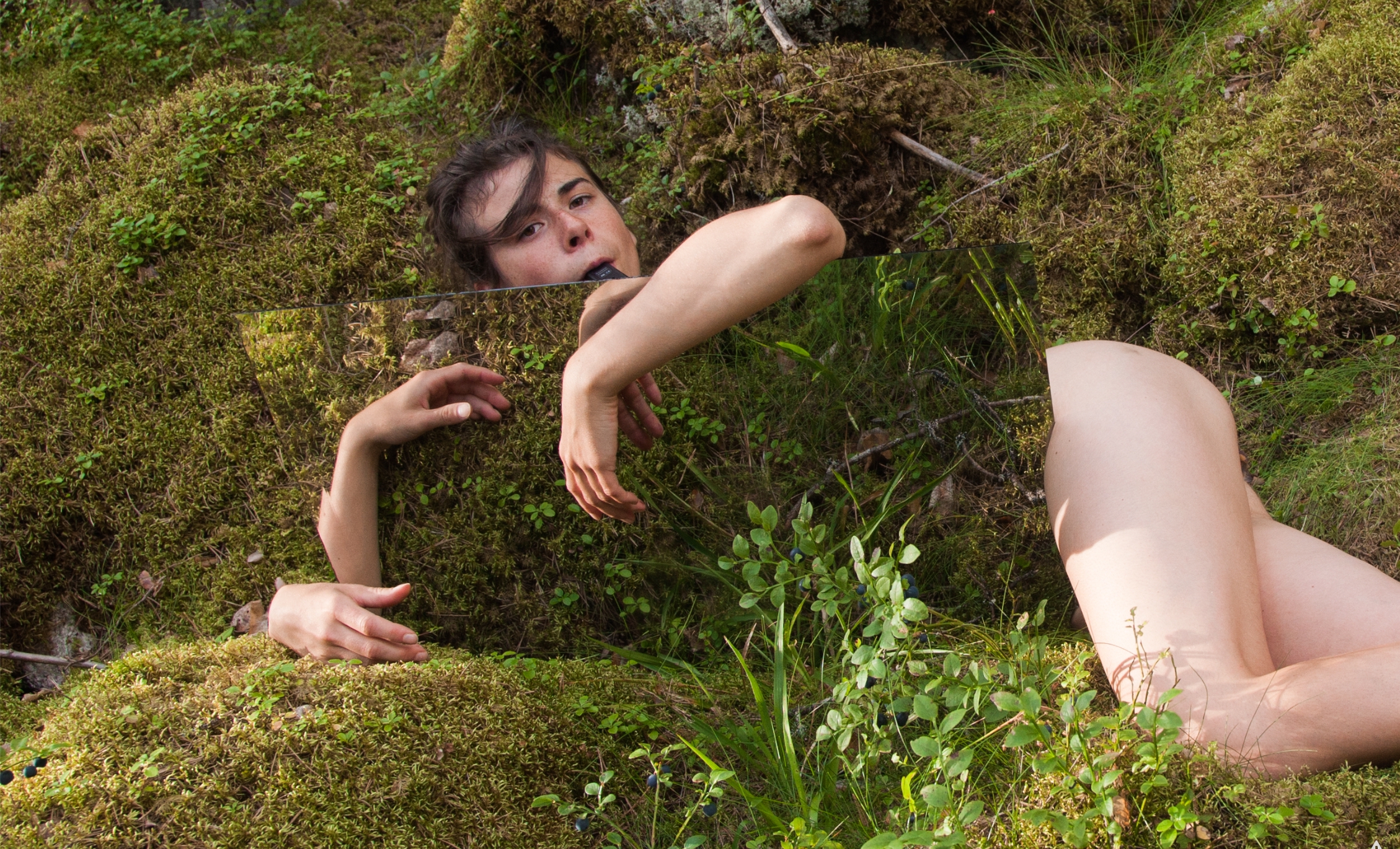
AW: After the residency in Japan, you found yourself in Haukijärvi, Finland, in 2016 and Reflecting on Nature (2016) was born. Correct me if I’m wrong, but was that the first time you ventured beyond a confined indoor space and started to explore nature?
LP: Yes, you’re absolutely right.
AW: Do you think your experience in Japan might have played a part in that?
LP: Perhaps. I do remember really wanting to photograph nature in Japan. It somehow just wasn’t translating in the photographs I was taking at that time — how mystical, magical, ethereal, all those delicious adjectives… I just didn’t know how to capture that. Perhaps, I merely gravitated toward what I knew how to capture well — myself indoors as part of the interior.
As you mentioned, Reflecting on Nature was the first work, seen publicly, that I captured completely outside in nature, and I loved that work so much. And, I am about to also say, I dislike it a little bit now, though I want to refrain from saying that. It’s just… to this day, this work has been repeatedly published and talked about. It’s attracted a lot of attention, and that’s a beautiful thing, which I am grateful for, but sometimes I think, gosh, there is so much more I have created beyond that — it’s honestly a love-hate relationship.

AW: When I Google you, that’s probably the number one work that pops up. I don’t know if you still want to talk any more about it.
LP: I can try sharing some of the things that aren’t covered in the articles, or maybe they are. (laughs) My gosh, I’ve talked about this work a lot…
So while I was there, in Haukijärvi, it was incredible to experience the 20 hours of daylight… you could be photographing at 11 p.m., and it would look like 4 in the afternoon. I spent a lot of time outside trying to figure out what I could create.
Then one day, I saw a mirror in my bedroom and I was intrigued, to see what it could look like out in the open outdoors. Originally, I just anticipated creating surreal-like photographs. It was kind of crazy because the residency was only a month long, and at week three, I had a “light bulb” moment — abruptly having this revelation about what to photograph, which eventually became Reflecting on Nature. So all the photos you see in the series, I created within a 9-day period, more or less, which involved tons of trial and error.


The title, concept, and artist statement also emerged only during the creative process — this question kept echoing through my mind: “What if Nature looked at itself in the mirror? What would it see?”
I was reflecting on the whole experience, and I remembered one very specific day, when I wanted to capture the sunrise reflected in the mirror, with the moon in tandem with it. On the first day, I awoke at 5 a.m., only to realise I needed to rise a bit earlier. The following morning, I got up at 4 a.m., and realised that I needed to wake even earlier. By day three, after two trial runs, I finally grasped the necessity of waking up at 3, arriving at the location, finishing setting up by 4, starting to photograph by 4:30 to capture the sun and moon at once, and wrapping up the shoot by 5.
And it was in that moment where… it was almost like this epiphany, with this realisation that I had to adjust myself, my lifestyle, to nature’s schedule… I heard it again: “What if Nature looked at itself in the mirror? What would it see?” But this time, I responded with another question: “What would we be?”
I used to say or think to myself, “Oh, I love nature, I’m so grateful to have nature in my life,” etc., where in fact, Nature is not part of my life — I am part of it. We are part of Nature.
So that’s the back story, and this epiphany or revelation was eventually presented as the concept. It’s like the work just happened — it came through me, and it was a very special series for me, at the time.
There was something else I wanted to mention, but it slipped my mind.
Anyway, it will probably come back!

AW: So London in 2017…
LP: Oh, I just remembered what I wanted to say! It’s not strictly about Reflecting on Nature, but it is related, and pertains to other works, on how I see myself in them, now that I am outside of them — this is a very quick anecdote.
What I find truly fascinating is that in all the work I do within domestic spaces, I always seem to aim at disrupting them — the interior’s appearance, the way one views the scene in a room — like when I turned myself into a lamp in one of my photographs, for example. On the other hand, the work I do in nature, is always about my camouflaging into it: becoming part of and being one with Nature.
I didn’t notice this until… perhaps… last year. Truth be told, nature and the outdoors are, in fact, what I really gravitate toward, and feel most connected with.
And then when I look back, and reflect on chapters of my life, where I felt I was indoors too often with too much of a domestic lifestyle, or I had too much of a predictable routine, or in a relationship where gender roles were becoming apparent, I started feeling trapped.
When you feel trapped in something, what do you do? You go and disrupt it, or interrupt it. Well, that’s what I was doing in a lot of those works.
What is consistent throughout all my work, despite different life circumstances, is that I’ve often used myself within it — it’s simply a matter of how my body is captured and exists within the environment that shifts.

AW: Thank you, that does sound fascinating. What I was gonna ask is, why did you feel the urge to go back to school? You had all these residencies and everything else going on.
LP: At the time, and before 2017, I was living between Manhattan and Brooklyn — that’s where my life was. After the Fashion Institute of Technology and continuing my practice, with travelling and all… a lot of positive things emerged, but something in me wanted more, or rather, wasn’t fully aligned.
During every residency — which I attend only during summers — I felt so in tune with where I could be and what I could be doing with my life. Whenever I returned to Brooklyn / Manhattan — it’s not that I was unhappy, but I felt this void — as if I wasn’t where I was meant to be, even though I didn’t necessarily know where else I could go or what else to do.
At the time, I always felt that art residencies were like an oxygen tank that I would grab onto to feel alive, breathing from it, until the next summer’s art residency.
A series of events led me to a conversation with an art agent one day, who casually advised me to consider doing a Master’s at the RCA, so that was a little seed planted in my head… I think that was in 2015.
Back then, I wasn’t really thinking about going back to university, especially outside New York. If those thoughts ever came up, it was more like, should I go to the School of Visual Arts or NYU? etc. — everything revolved around New York City for me at the time.
After she mentioned the RCA, it was like I felt another pull. I was curious. I honestly believe in listening to our intuition because that is something we are all innately born with, it’s our mind that sometimes restricts us from making decisions best for our growth.


Afterwards… there was a point when I was visiting France with my partner at the time, and he invited me to a ball in Versailles, alongside other events, and I recall feeling so out of place.
Then, out of the blue, this art agent’s voice came back to mind, telling me to visit the RCA — her words ringing in my head, I felt the pull again — I knew in my heart, that I had to go to London — I let my partner know, and the next day hopped on a night bus that arrived in London at 7 a.m. the following morning. I remember everything feeling so refreshing after leaving Paris. Also, it felt strangely familiar, as though I had been there before… firstly, everyone was speaking English — maybe that was it — with a British accent (laughs), the simple things in life.
So, I had a whole day to check out London before my bus left in the evening to return to Paris. I went straight to the university… around 8 a.m., I naively perceived I could just walk in and look around — not the case, of course — I wasn’t allowed in without an appointment. Also, no staff were there… as it was summertime, I did not really factor this into my “plan of attack”, so when I arrived and learnt from the security guards that I wasn’t getting in, I just struck up a conversation with them over a coffee, since I didn’t have anywhere else to be.
They were super interesting and so lovely. I’m still in touch with one of the guys, Sid, via email. I guess you could call it serendipity — a bit of luck — because while we were all chatting and sharing life stories with one another, Sid was like, “Hey mate, the head of the photo programme just walked in.” I was like, “Oh, cool!”, not perceiving that I was going to meet them, but then he said, “You know what, why don’t you come with me?”
He introduced me to one of the heads of the photography programme, Hermione Wiltshire, and she showed me around the Photography floor — it was such a blessing of an experience.
I applied for the course, and I was accepted the following year. The RCA to me was a very special chapter in my life — one I’m so grateful for — it was like a door that opened so much potential for the future.

Footnotes
1. Arata Isozaki (磯崎新, 1931–2022) was a renowned Japanese architect known for his innovative and eclectic designs, blending traditional Japanese elements with modern architecture. He received the Pritzker Architecture Prize in 2019 for his significant contributions to the field.
Credits
Editor: Axel Wang & Loreal Prystaj
Photography: Courtesy of Loreal Prystaj