
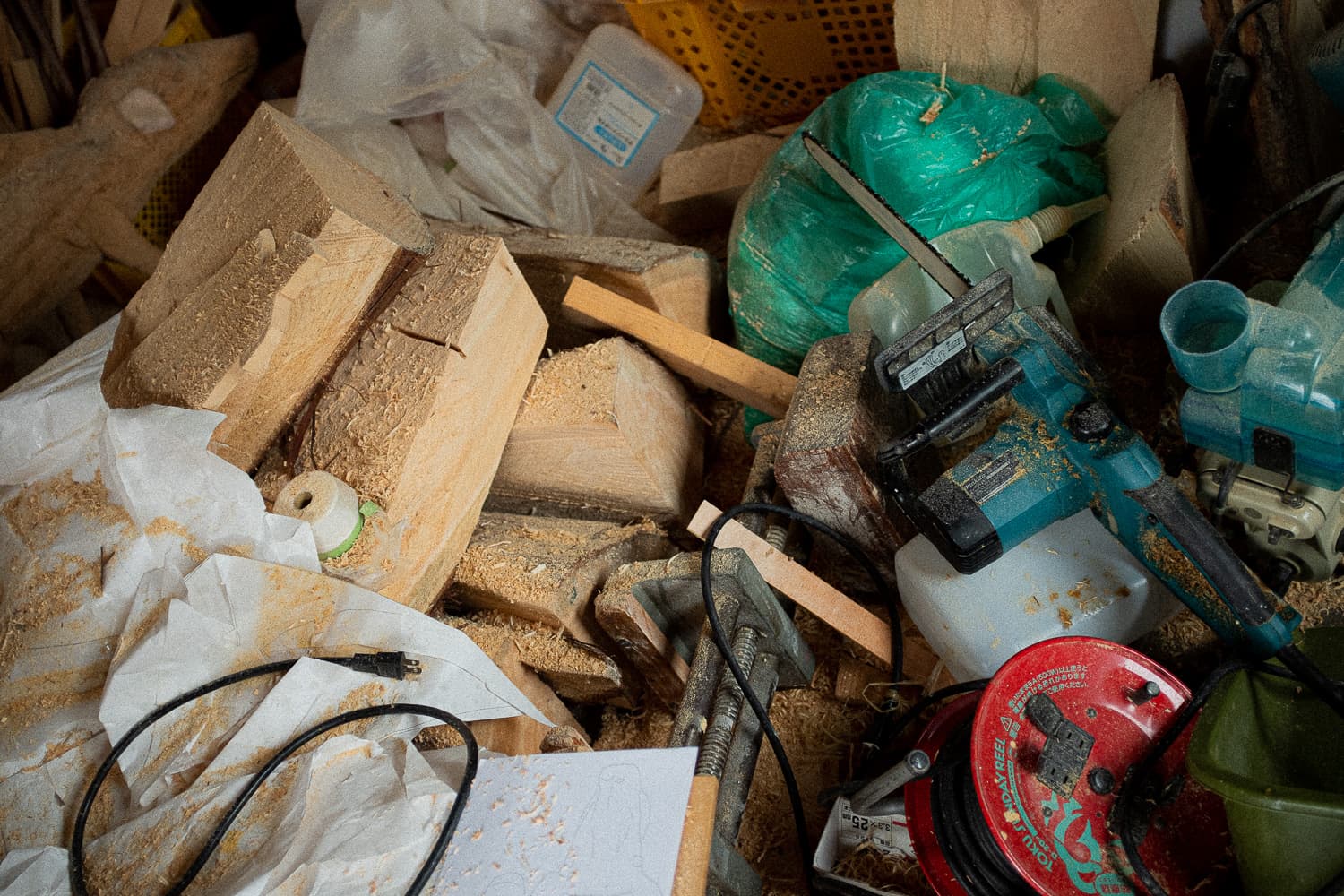
Before the launch of GROWING SPACE (2022), we visited Mitsunori Kimura (木村充伯) at his studio towards the end of July.
A train ride of less than two hours took us from Nagoya (名古屋) to Fukuroi (袋井), Shizuoka (静岡), where the artist lives and works. We also had the opportunity to speak with Kimura-san about his life before becoming an artist and what it’s like to be a sculptor. Of course, it was a pleasure meeting his lovely family. Please find our interview and photographic documentation of the visit below.
AXEL WANG:
Kimura-san, first of all, why did you decide to pursue sculpture?
MITSUNORI KIMURA:
People sometimes consider sculptures as artworks, and sometimes they don’t. I’m interested in the boundary between artwork and the real world, and I believe sculpture can act as a bridge between the two.
AW: Was there a point when you decided to become a full-time artist?
MK: Not exactly, it was more of a natural progression of events really. Before, I never thought about selling my works, so even when there were enquiries, I always just refused. When I first started working as an artist, I also had a job at a university, so I wasn’t particularly troubled by money, and I didn’t have that many works either. At the time, I used to think that if I had to sell my work to someone, I would rather just buy it myself, if that makes sense.
However, as my career progressed, the number of works increased, and it became impossible to store all of them. There were financial constraints too. So, after a few exhibitions at commercial galleries, I gradually began to find joy in selling my work.
AW: I can imagine it’s not easy in the beginning.
MK: Back in the day, every morning when I woke up, I would ask myself whether I wanted to continue working as an artist. But whenever I thought about the compliments from Pier Luigi Tazzi, he was an art critic and curator who sadly passed away last year, I felt encouraged. We met when he was the curator of Aichi Triennale 2010. I used to show him my work, and I still remember his very positive reaction to Oh There Is a Dog! (2010), and afterwards he exhibited my works in Italy. Moments like that kept me going
After I quit my university job, I had opportunities to present my work at commercial galleries, so income wasn’t a massive issue, though I had to admit that there were times when my account balance was approaching zero. Even then, I never seriously considered quitting. I just kept going, hoping the works would eventually sell.
AW: Let’s talk about your inspirations, Kimura-san.
MK: When I was a junior high student, I used to love reading about the wooden cat sculptures in art textbooks. In high school, I found the works by Katsura Funakoshi1 enormously intriguing. Later at university, I was taught by Eiji Watanabe2 to create a sculptural interpretation of the Red Man, painted by Georg Baselitz3. Through the motif, I gradually began making my own animal sculptures using wood and oil paint.
I guess I’ve never really had a strong sense of reliance, or maybe trust even, in too many people since elementary school, so I think Watanabe-san is definitely my strongest influence. About 10 years ago, I also noticed that my work shares certain similarities with that of Takesada Matsutani4.
I create three-dimensional objects using oil paints, and I use a chainsaw to create hair-like texture on the surface. These methods avoid direct contact with the material. Matsutani-san, on the other hand, uses a lot of vinyl adhesive in his work, allowing it to be shaped by elements like gravity, heat, or even wind. In a way, it creates a sense of distance between the object and the viewer.
During my student years, I encountered Mono-ha5 quite often, so instinctively I thought the movement influenced me. But perhaps without realising it, I was also influenced by the Gutai6 group. Later, as I did more research on Matsutani, I learnt that he was indeed, a member of the Gutai group led by Jiro Yoshihara — I came across his motto: “Don’t imitate others”7, which I found quite compelling.


AW: When did animals become such a dominant presence in your work?
MK: I remember since around 2004, I’ve consistently made animal-related works — if you could even call them “works”, like we used to make cats and dogs posed like humans, or sort of turned humans into animals. When the COVID-19 outbreak began, animals became a focal point because they were seen as potential carriers of the virus.
During the pandemic, I was trying to focus on the act of breathing by the lungs, for obvious reasons. At that time, I had the ambition to create works representing all the mammals that existed on Earth. In the end, I managed to create the faces of 958 of them. After that, I compiled them into a pictorial catalogue, and it reminded me of a simple fact I had almost forgotten: humans are mammals too. It made me realise how strong the connection is between animals and us — I find that endlessly fascinating.
AW: You mentioned creating hair on sculptures using a chainsaw, can you tell us more?
MK: It’s a technique that I have been experimenting with in recent years — creating hair on the surface of human and animal sculptures — imagining hair growing out of the wood itself. It’s a process which involves the operation of a chainsaw, fluffing repeatedly on the surface, basically. So it depends on the characteristics of the material, it’s only possible with a certain type of wood.
AW: Is there a message that you are trying to convey through your animal sculptures?
MK: Not consciously, I don’t bear any messages in mind when I make work. But depending on the context, it can take on meaning. Obviously, the interpretation is left open to the viewer. In general, what I would like to create are animals that breathe and tread this land.
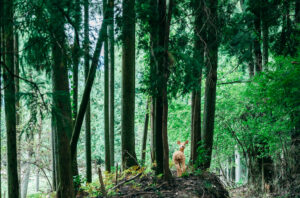
For instance, in The Deer is Gazing (2020), when viewers make eye contact with the deer sculptures, the spectacle reminds them of death in the natural world, because in real life, making eye contact with wild animals can put you in danger. On the spot, you feel some sort of tension, and of course, some would find that the deer is cute and so on.
In Into the Forest (2020), I depict deer eating trees. As you may or may not know, deer have four stomachs, and they will eat just about anything, like tree bark. And this is said to have contributed to deforestation to some extent. In this work, you see that the deer’s heads are buried deep inside the trees, as if they are so absorbed in munching up that they fail to notice anyone approaching — ends up becoming part of the forest.
AW: I remember standing in front of a massive painting by Anselm Kiefer, there was this feeling of awe — it was a mixture of respect and wonder, and even fear. I personally think that the human brain is wired to be impressed by large-scale objects because, when you think about it, we are tiny creatures compared to nature! Anish Kapoor on the other hand, once said that, being big can be meaningless when it comes to art, the point of the scale has to relate to what it’s about, the content and the context. Has the thought of creating giant-sized sculptures ever crossed your mind?
MK: You are definitely right there, large-scale works do have a strong presence and charm. I have thought about making it, but to be honest, the size of the work has never been my concern. And I guess whether the object feels large or small depends entirely on the space. So for me, the more important question is what to create, not how big it should be. The works I make are always life-sized, they are not necessarily a realistic depiction of actual animals, but they do carry a certain sense of realism.
AW: Kimura-san, do you find time for any hobbies outside of making art?
MK: I enjoy filming and watching videos of my singing (laughs), especially when I try to imitate a female singer’s voice!
Footnotes
1. Katsura Funakoshi (舟越桂, 1951–2024) was A Japanese sculptor known for his quietly introspective wooden figures, often rendered with elongated forms and painted surfaces. His works explore psychological presence and a subtle tension between stillness and emotion.
2. Eiji Watanabe (渡辺英治) is a Japanese artist and educator whose teaching has influenced a number of younger sculptors. His practice bridges painting and sculpture, often encouraging reinterpretation across mediums.
3. Georg Baselitz is a German artist associated with Neo-Expressionism, known for his inverted figures and raw, confrontational imagery. His work challenges conventional ways of viewing painting and representation.
4. Takesada Matsutani (松谷武判) is a member of the postwar Japanese avant-garde artists. Matsutani is recognised for works using vinyl adhesive shaped by natural forces such as gravity and time. His practice often introduces distance between the artist’s hand and the final form.
5. Mono-ha (もの派) is an influential Japanese art movement from the late 1960s that focused on the relationships between natural and industrial materials. Rather than shaping matter, artists emphasised its inherent properties and presence.
6. Gutai (具体) is a radical postwar collective founded in 1954 that embraced experimentation, performance, and material engagement. Gutai artists sought new forms of expression by pushing beyond traditional artistic conventions.
7. Jiro Yoshihara (吉原治良) was the founder of the Gutai group. Yoshihara advocated originality above all. His oft-cited statement reads in full: 「人のまねをするな、今までにないものをつくれ/ Don’t imitate others; make something that has never been done before」
Credits
Editor & Photography: Axel Wang