
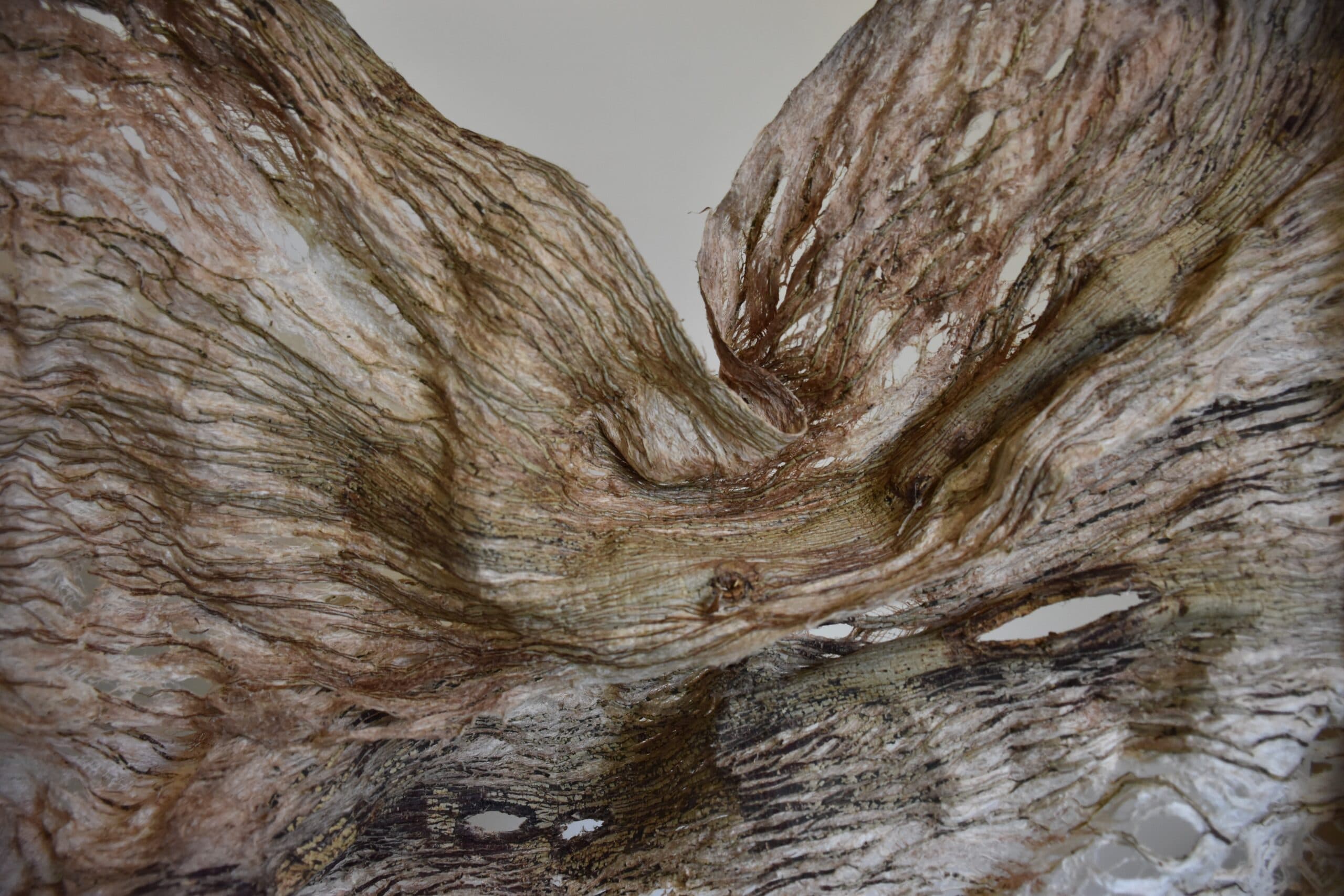
Let’s pause for a moment and recall what life was like before the pandemic, does feel like a lifetime ago, does it not? Thinking about it, the life we had before was somewhat like an alternative timeline, like one of those Marvel multiverses, you could draw correlations, but they are never quite the same. It was a time when every beautiful face of human beings was not hidden behind a tedious mask when, you didn’t have to constantly remind yourself about alcohol wipes and hand soap, when you could just sit down in any restaurant or bar without the slightest worry that you might possibly be exposed. Some life we had back then, eh?
As I write this, it has been 2 years since my last trip to Taiwan, which was the last time I boarded an aeroplane, also the last time I went beyond the borders of the Japanese islands. I looked at the photos I took in Taipei, I read the notes I jotted down in museums, trying to recollect and piece together the fragments of memories that sprang from the trip. I remember the food I ate, the streets I strolled, the miles that I walked — it was a devastatingly tiring trip.
I landed in Taipei after spending a week in Tokyo during the New Year break, and straight off to the Asian Biennale in Taichung I went, then several blockbuster exhibitions back at the Taipei Fine Arts Museum. It’s always exhilarating to see and experience new works of art in a foreign city, though it can most certainly be exhausting at the same time, dealing with different cultures, customs, and of course, people. I remember approaching the end of my journey, I was so physically worn out and mentally drained, reaching a point where I just felt, that really was enough, and I simply couldn’t take it anymore. “Let’s get this over with.” — I was so ready to just pack the camera away, and forget about all of this artsy stuff, head out of the museum, and just, feast.
Then something shifted.
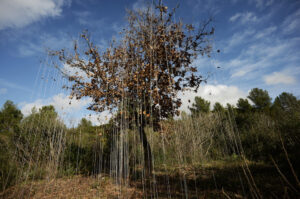
It wasn’t until the minute I arrived at the ground floor of the museum, in front of an installation work of pine trees named Disembodied Posture (不存在的姿態) situated in a 20m² box, I remember it was close to a feeling of revelation.
It was like a reboot, a moment of invigoration struck the second I entered the space and laid eyes on the work, as if it were demanding every bit of attention from the viewers, all my random and scattered thoughts were seemingly extracted by it, and I was able to focus once again as I stood there, immersed, gazing, trying to take it all in. The room felt serene and virtually reclusive that it seemed to be cut off and detached from everything else happening inside the museum. I took a breather and started to wander, from one element to another, studying all the details. It was as if I were overhearing a quiet conversation between the lights and the shadows, the objects and the reflections, like my presence had been detected, slowly, all the pine trees responded, appearing to have come alive once more and beginning to thrive, the lives of these objects started to unravel right in front of my bare eyes within the confines of this space.
Of course, occasionally, someone would step in for a selfie, but that didn’t take anything away from the whole experience. Before leaving the exhibition space, I took a quick glance at the caption, ‘Yi-Ting Wang’, a collaboration was already brewing in my head, and I knew one day I would have to work with this artist.
The past imperfect is a grammatical tense that doesn’t exist in English but in French, describing an unresolved state or action in the past being carried on into the present and possibly further. Perhaps as a culmination of her years spent in France, Yi-Ting’s work evokes a powerful sense of, not nostalgia, nor a reminder of any history, but more of an unfinished process from the past continuing, and stretching into an unforeseeable future. Her work speaks not only of the natural objects, but of time and life itself.
There’s a line in Forest Gump, “Death is just a part of life. It’s something we’re all destined to do.” Haruki Murakami also wrote in Norwegian Wood: “Death is not the opposite of life but an innate part of it. By living our lives, we nurture death.” Death, alongside love and war, probably plays the most significant roles in the history of literature. Yi-Ting’s work sculpts a narrative surrounding the notion of death and encapsulates the essence of existence. Her attempt to extend life beyond death, further opens up a broader dialogue on how death is perceived and valued differently in the East and the West. Does death mean the end, or is every ending another new beginning?
Now, 2022 has already arrived, yet the pandemic shows no sign of fading away any time soon. In fact, the situation is looking bleaker than ever, and perhaps one should not take for granted that tomorrow will always be a better day. Whether it’s a turn of natural selection, or purely the impotence of governments, we do not know, all we know is that it’s still hitting everyone hard, ourselves included.
In October last year, amid this uncertainty, we were fortunate enough to participate in Unknown Asia, collaborating with Yi-Ting at the art fair in Osaka. Together, we had to locate a new system of pandemic curation, for an intensive and challenging couple of months building up to the day of the exhibition, we navigated our way through, and worked collaboratively from a distance, conversing via computers and phone screens. On top of all that, thanks to the help of a few other individuals, we managed to pull through, and we couldn’t be more thankful to Yi-Ting, who decided to join us on board despite the short notice and crazy schedule.
Upon the conclusion of the project, our conversations with Yi-Ting continued. In the first part of this interview, I asked the artist about her past, the time she spent in France, and her influences. In the second part, we turned to life and death, which have been the core of Yi-Ting’s ethos and artistic practice. She also shared with us some of her interests in works of sci-fi, as well as her plans for the future. With the arrival of 2022, notwithstanding the written pessimism, let’s keep our fingers crossed and hope for a better year to come.
Past Imperfect
AXEL WANG:
讓我們把時間往回撥一下。您小時候是個怎樣的小孩呢? 有什麼家庭方面的影響, 或者是因為看到了某件藝術作品讓您有立志當一名藝術家的想法嗎?
Let’s go back to the very beginning Yi-Ting. What were you like as a child? Did you always want to become an artist? Was there any particular influence from your family or elsewhere, or a specific piece of artwork that inspired you to pursue this path?
YI-TING WANG:
我出自一個普通的家庭,家人沒有特別培育我在藝術方面的發展。小時候接觸藝術的機會較少,大部分讓我感到震撼的藝術作品,都是在去歐洲留學之後才接觸到的。藝術的啟蒙回想起應該是在中學時,偶然有機會參加了紙雕的競賽,並且得獎,從此便對創造立體物件產生了興趣。在競賽準備期間,老師鼓勵我自主研究紙張的色彩和結構關係,我常常在美術社流連忘返地挑選紙張,研究材料與工具的使用,逐漸發覺了材料實驗的趣味,以及各種天馬行空的創作方式。
I come from an ordinary and humble family, and my upbringing did not involve anything specifically related to art. There were few opportunities to encounter art when I was young, most of the works that truly moved me were ones I came across only after I began studying in Europe. Looking back, my interest in creating 3-dimensional objects was initially triggered back in junior high school, when I happened to participate and won a paper sculpture competition. During the preparation process, the tutor encouraged us to explore the relationships between colour and structure in paper by ourselves. I often lingered in the art room, selecting paper, experimenting with different materials and trying out different tools, and gradually discovering the joy of material exploration and the many imaginative ways of creating.
“…只想對自己提出的問題尋找一個答案…”
“…I wanted answers for myself…”
AW: 東海⼤學畢業後,您在將近5年後的時間內去往了法國⾺賽繼續學業。有什麼契機或者原因,讓您決定在那個時間點做出這樣的決定呢?
You went to Marseille to study art nearly 5 years after graduating in 2008 from Tunghai University. It almost feels like a reset button in life. What led you to make that decision at that particular time?
YW: 我其實在大學畢業後不久就先到上海工作了一段時間,主要從事商品企劃以及管理。當時的公司是做琉璃藝術的,領域介於藝術與設計之間,因此免不了需要研究東方藝術文化,對於東方美學以及哲學思考有一定程度的理解,才能企劃出相應的琉璃作品。在製作上,也必須解材料的特性以及工法技術,更要在傳統的雕塑美學中尋求創新。因此,那段時間對我來說是非常寶貴的經驗,得以磨練自己駕馭商品的能力,從企劃到成品的一切細節。
久而久之,我開始對藝術有了一番不一樣的想法,試著向自己提問,藝術是否只是眼前所見的這般光景?或是藝術還能有其他的可能性?儘管我在大學時主修的是工業設計,但回頭看,其實對藝術仍然一無所知。當時的我真的很年輕,下了要學習藝術的念頭便不再回頭,立即開始準備出國的計畫。回想起,當時的決定非常蒼促,我對法國一無所知,也沒有考慮到法語以及申請美術學院的難度,只想對自己提出的問題尋找一個答案。當下的我並沒有覺得那是很困難的抉擇,除了經濟問題需要解決外,其餘的事情,我都覺得可以先到了那邊再慢慢解決。我當時想的是,如果我現在不做這個決定,未來可能再也不會有同樣的機會,所以無論如何都想試試看,哪怕只是去一下下也好。
I actually spent some time working in Shanghai after graduation. The job had something to do with product planning and management, and the company mainly focused on Liuli (Chinese coloured glass) products, which sit somewhere between art and design, so I obviously had to research and familiarise myself with Eastern art, to develop an understanding of the aesthetics and philosophies, in order to create appropriate work. From a production perspective, it wasn’t always about coming up with something creative and new, that differed from traditional craft, I also needed to understand the properties of the materials and the technical aspects of the production process. From proposal and planning, to the actual realisation and manufacturing of the final product, minding every small detail along those steps, it was an extremely valuable period of time for me.
Over time, after working there for a while, I began to have my own ideas about art and started asking myself: Is this all there is to art, just what lies before our eyes? Or could it be something more, something else entirely? Although I majored in industrial design at university, I knew very little about art.
At that point, I was simply dying to learn more. I suppose that was me being young, and I was so determined. Once I made my mind up, that was it, I never looked back. I immediately started planning to go to France, a new country and a new language, which I also knew absolutely nothing about, without even considering whether it would actually be possible for someone like me to study at an art college there.
Aside from financial concerns, it didn’t feel like a difficult decision. I wanted answers for myself, the rest, I believed I could just figure out once I got there. I also felt that if I didn’t take the plunge then, I might never have the same opportunity again, so I had to try, even if only briefly.
AW: 在台灣與在法國⽣活與⼯作, 從各個層⾯上來看, 相⽐之下有什麼不同呢?
How different is it, when you compare living and working in Taiwan to France?
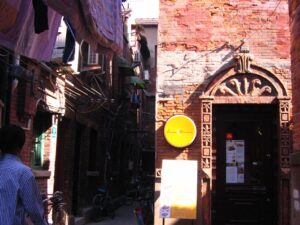
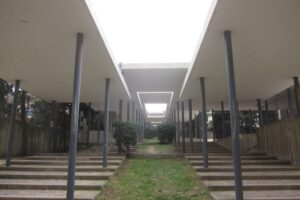
YW: 這個問題牽涉很廣,我很難很詳細地回答。對我來說,法國和台灣文化之間存在著非常大的差異,以至於我剛到的時候經歷了很強烈的文化衝擊,花了很長的時間去適應。我感覺學習了一年半的法語後才開始了解語言,進而慢慢了解文化,情況才逐漸好轉。自從我學會法語後,彷彿開啟了另一扇知識和文化的大門,我常常在法語模稜兩可的語境内百般揣測,也經常在腦袋中切換法語、英語與中文的不同語境。語境不同,思考的方式也隨之改變,之後我也慢慢嘗試學著用法語思考,甚至自言自語。
剛到法國的時候,可能還能清楚分辨哪些是不同,哪些一樣,但住了五、六年後回到台灣,自己的言行舉止卻似乎成了外國人。也很難分辨究竟是原本的習慣使然,還是因為在法國生活所帶來的改變。
It’s quite a big question, so I can’t really give a specific answer. For me, the cultural chasm is profound. I remembered experiencing a tremendous cultural shock at first, and it took me a long time to adapt. The situation improved after I began learning the French language, it felt as though another door had opened. I think every language has its own nuances. In the beginning, I had to constantly switch between French, English and Chinese in my head in order to understand the context, but gradually I became more comfortable with French and was able to think in it, sometimes even talking to myself in French.
At first, it was all about the differences between the two cultures, but after spending 5, 6 years in France and then returning to Taiwan afterwards, there were moments when I felt somewhat out of place, like it was so strange. I couldn’t quite tell whether it was due to French influence or simply who I was, I felt very much like a foreigner in my own homeland, the way I spoke and behaved just seemed so out of sync with those around me.
AW: 在台灣出⽣長⼤, 加上在上海及法國學習⼯作, 各種經歷有給您的藝術創作帶來怎樣的影響嗎?
Having been born and raised in Taiwan, and having worked in Shanghai and studied in France, how have these experiences influenced your artistic practice?
YW: 法國可以說為我提供了對藝術一切認知的養分。在求學期間,我得以利用地利之便,前往歐洲各個地方參觀展覽,增廣見聞,也在巴黎看過幾場印象深刻的藝術家個展,例如2014年在巴黎大皇宮的Bill Viola、2015年的Mona Hatoum、以及Pierre Huyghe、Edward Hopper、草間彌生等。而每兩年一度的維尼斯雙年展更像是一場場身心的洗禮,從中總能感受到藝術家們對創作的熱情與思考。
求學期間我曾在藝術家Michel Gouery的巴黎工作室實習。相較於陶藝技巧的學習,真正影響我的是他持之以恆的創作動力,創作如日常,成為一種習慣,至今這樣的創作精神仍然持續影響著並提醒著我。我个人創作的影響多半來自於生活。尤其當長期身處於文化差異下,對於周遭的環境會多一份警覺性,即使作品不會特別說明,但這種感知會自然地滲透其中,成為一種潛在的脈絡。
Artistically, I think France has nurtured me in every possible way. Geographically, it was convenient for me to travel and explore exhibitions in the surrounding countries. I saw Bill Viola at the Grand Palais in 2014 and Mona Hatoum in 2015, as well as works by Pierre Huyghe, Edward Hopper, and Yayoi Kusama, and visited the Venice Biennale. I was able to connect with artists’ ideas and their passion for creation, all these great names and art festivals inspired me profoundly.
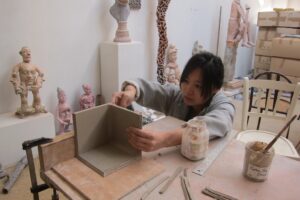
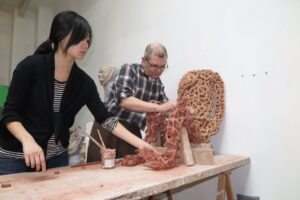
During my studies I interned at Michel Gouery’s studio in Paris, and for me, the experience was less about the pottery crafting techniques that I got to learn, but what truly influenced me was Michel’s persistence and daily commitment to creating. For him, creation was part of everyday life, it had become a habit.
My work is largely influenced by life itself and my immediate surroundings. Especially being situated in a different cultural environment for an extended period, you become constantly alert and attentive to everything around you. Cultural differences and contrasts are not explicitly the subject of my work per se, but they remain hugely important, ike an undercurrent.
Footnotes
1. Michel Gouery (b. 1956) is a Paris-based artist known for his work in ceramics and sculptural forms. His practice emphasises material exploration and a disciplined, process-driven approach to daily creation. His work often centres on the quiet dialogue between material, form, and time, treating making as an evolving, continuous act rather than a fixed outcome.
Credits
Editor: Axel Wang
Photography: Courtesy of the artist