
Smell
SOICHIRO KIMURA:
Let’s start with smell.
YUKA FUKUSHIMA:
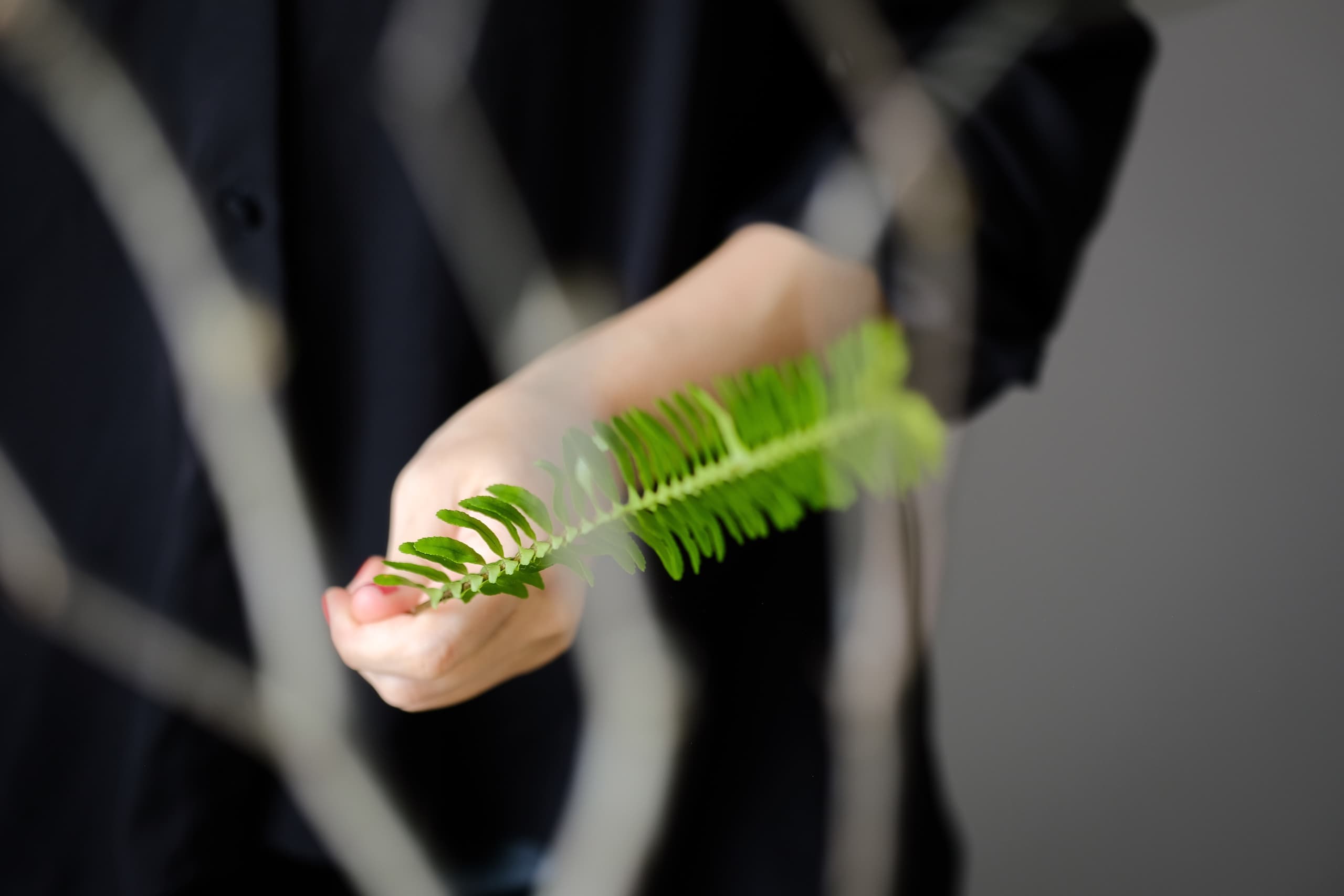
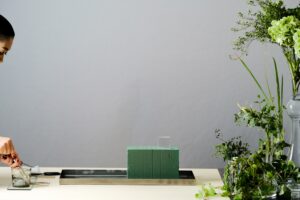
You might have noticed that the smell of plants changes according to the temperature and the environment. When it cools down, the plants toughen, and you can just about witness a rise in the blueness and depth of their colour — like crystal; conversely, as it turns warmer, they become softer and smell incredibly gorgeous. Imagine floating a piece of dry plant on any watery surface, shaking it, and taking a sniff – a stronger aroma from the plants will be released due to its cell destruction. I wanted the audience to feel these changes and possibilities, as well as create a new scent by mixing up a variety of distinctive smells, which was also the idea for the installation this time at SYNONYM. What I was also hoping to experiment with was how to preserve the original olfactory characters of the plants through distillation. The purifying process would remove any contamination and foreign elements. If successful, we would potentially be able to experience that organic, fresh smell from the plants at any time of the year.
Do you remember that first time when you walked into the forest? When you were out in nature, standing among the woods, when you smelled that fragrance of morning dew and forest air, hearing the sound of flowing rivers, our bodies are able to memorise all these sensations, according to the Proust effect – that smell does trigger memories. The theory always comes to my mind whenever I create, drawing that connection between plants and people. Hopefully, my work can evoke something they have once experienced and allow them to relive those events again. Plants are an integral part of human lives; this piece I created for the exhibition also serves as a reminder that we are indispensable to one another.
Distillation
SK: We titled the installation piece Distillation. Have you been experimenting with the actual process for long? I assumed it’s not a required task at work.
YF: Initially, I was investigating water as a subject without being overly interested in the notion of distillation. Being a floral designer, understanding the quality of it has always been an imperative part of the job; we have to ask what type of water is best for different plants, and where to find it. In reality, plants can survive with the tiniest dose; even in the desert, they manage to absorb it from the air and the underground – that’s where the cycle begins. The quality of water will affect the well-being of the plants, which would then alter the quality of the air.
In some ways, I suppose this also applies to humans, since around 60% of our body is made up of water, and its properties vary across regions of the world; ultimately, this would affect the air we breathe. Being born in Nagoya (名古屋) means I was nurtured by the Kiso River (木曽川). When I go on trips, I always pay close attention to what the locals have to offer. I’ve had this wild thought since I started working with my family that one day, somewhere, eventually, I would be able to locate the water that is just right for my own body. I wonder if that would change me in any way.
My initial trigger for diving further into “distillation” occurred when I went on a research trip to one of the distilleries specialising in crafting gin in Gujo (郡上), north of Nagoya, in order to test out the possibility of retaining the aroma of plants through distillation. The impression was that such a process is primarily used for brewing liquor and sake. To my very surprise, the gin I tasted at the distillery wasn’t how I had pictured it; even though it was neat and extremely popular on the market, I thought it wasn’t really my personal favourite at that moment.
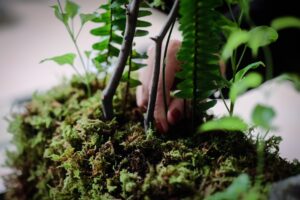
I soon departed for the mountains at Gujo after hearing advice from the craftsman before jumping to any conclusion. Needless to say, the air up there was on another spectrum; the altitude was high, and it was extremely slippery and dangerous due to the growing moss. Once I smelled the air, I wasn’t going to miss the opportunity to try the river water despite everything. It turned out to be an incredible experience. The river looked beautiful and radiant, almost as if it were a living creature. It would be an understatement to say that I was shocked by its taste. In contrast to the water from most parts of Japan, which is soft and lacks minerals, here it was hard and flavoursome; it was even glowing with a bluish tone under the sun. I then mixed the river water with the gin that was brought along, and voilà – the gin seemed to have evolved and metamorphosed due to the added river water. It became so delicious, and my initial suspicion about the gin was completely eradicated. The impact of the water was phenomenal.
By the end of the trip, I just thought, I wish I could preserve all of this – all the emotions, even the commotions. If I could distil that crisp taste of the river and the gin, the sense of having that graceful breeze passing through my hair and the warming sunshine glancing on my face, the feeling of reaching out for the rocks on the mountain and treading cautiously among the forests, the rise in my body temperature and heartbeat – if I could preserve all the feelings and all the elements of delicate nature in one transparent glass bottle, wouldn’t that be something else? Once again, I asked the question of what the perfect water is, and how we extract the best out of it. This intended separation and preservation process was what led to my spark for Distillation.

Independence
SK: I understood that you decided to move away from the family-owned business Marimo-en (マリモ苑) sometime earlier this year, but I’ve never really asked you why. Gaining independence professionally, I think that takes a lot of courage.
YF: It has always been on my mind. I was looking for the right timing, that was all. I envisioned Tokyo, like many others, where things are obviously more accepted, and I went through phases looking for vacant properties for my business in the city. After a while, however, the idea just didn’t sit right anymore. I needed to be able to work with the right people, and again, probably like many, Tokyo was not a place where I felt I belonged. Hence why I thought it made more sense to stay in Nagoya, where I was born and bred, a city I also knew where to find the best nursery growers.
My older sister, who also manages the business, prefers things the way they are. On top of that, it has been continuously running for 51 years – more than half a century – which is amazing and terrifying at the same time, so fundamentally it’s not easy to change things. Clients are ever more demanding; a significant amount of time and effort is needed to keep the business afloat, and it’s achingly draining for my own creativity. Working at Marimo-en for 20 years and now approaching 40, I think it’s about time that I figure out what it is that I genuinely want as a person and a floral designer.
Japan
SK: You mentioned staying in Nagoya for the new solo adventure, do you think the city, or Japan overall, has influenced you?
YF: Being Japanese, I think we are typically concerned with small details and mundanity, and frankly, we are very good at it. For instance I like pochi bag1, washi paper and Sanada braid2 myself – trivial matters for a lot of people who aren’t Japanese, or unfamiliar with our culture. Matsuri (祭) and uchimizu3 are great examples too – the reflection of seasonality and seasonal presentation can oftentimes be so mundane that most would simply take it with a pinch of salt.
I remember getting a weird déjà vu while I was looking at part of the painting Rakuchu Rakugai Zu4 housed at the Kyoto National Museum. It depicted the detailed lives of common people in Kyoto during the Edo period so vividly, almost as if I were there. I guess we all fantasise about travelling back to the past to some degree, for me, the Edo period was perhaps the most captivating and inspiring, notably the culture. It’s also the time when the concept of Iki5 was formed, the aesthetic ideal moves me deeply, and it’s what I aim to embody personally and professionally too.
Art
SK: Personally and professionally, do you seek inspiration from contemporary art, though the term is rather vague?
YF: Lately, I particularly admire the photograph Kamiokande taken by Andreas Gursky; the abstract yet minimal expressionistic jet black paintings executed by Tomoharu Murakami – underneath all the layers and textures of black ink on dark canvases, the use of materials like charcoal powder, oil and acrylic paints, you see discipline and vision. His techniques of wielding knives and brushes to create are also astonishing. I also remembered seeing an installation work orchestrated by Shuzo Takiguchi (瀧口修造), summing up essentially, it was his study, for most it was perhaps merely a room filled with irrelevant objects, again everyday slices of life intrigue me. I discovered eggshells pinned with a memo stating “I would like to eat what’s inside one day6” — absurd but fascinating.
The list goes on, Ryan Gander, Yoshihiko Ueda (上田義彦), Lee Ufan, these are all very inspiring figures. I’ve never studied art, but it pains me to see how the contemporary art world is dominated by scholars or academics and marketing-driven conglomerates. It’s never about the name or reputation of the artist for me, but the vision and emotion that the artist is able to convey through his or her creations. You can almost immediately detect whether the intention of the work is to cater to market demand; there shouldn’t be any hierarchy in art either, take the Edo period as an example once more, there was none of that. Shunga7 for instance, the culture and art were more to do with commoners than with royalty or governments.
Future
SK: Becoming an independent designer, what plans do you have for the future?
YF: I would probably not start any ikebana8 lessons or workshops because I feel that it’s already a very saturated market. In my head, there are things that I would like to create – perhaps, for lack of a better phrase, a new style that differs from the majority of the industry, or somewhat of another aspect of what we as florists or floral designers can offer. It may not be the most interesting idea in the world, but speaking for myself, the crucial thing, once again, is to open up possibilities and ask the right questions. My mission is to connect people through plants, creating a pure and exclusive connection between both ends, without the necessity of attaching any words and explanations.
Footnotes
1. A pochi (ポチ袋) bag is a decorative, petit paper envelope given to children containing New Year’s or congratulatory gifts, usually money.
2. Sanada braid (真田紐) is a flat and braided cotton cord.
3. Uchimizu (打ち水) is a Japanese ritual that typically takes place during the summer, and involves sprinkling water in gardens and streets. Japanese people see it as exemplifying national values, as it combines utilitarian, aesthetic, courteous and fulfilling duties.
4. Rakuchu Rakugai Zu (洛中洛外図) is a series of screen paintings translated as “Scenes in and Around the Capital”, capturing the lives of the early capital of Kyoto.
5. Iki (粋) is a specific Japanese aesthetic concept thought to have formed in the Edo during the Tokugawa (徳川) period. It is generally considered an expression of simplicity and sophistication, associated with romance and ephemerality.
6. A literal translation of the original text in Japanese: 「いつか中身を食べたいです」
7. Shunga (春画) is Japanese erotic paintings that reached their peak during the Edo period, mostly ukiyo-e done on woodblock, literally translated as “spring painting,” where “spring” is a common euphemism for sex.
8. Ikebana (生け花), the Japanese art of flower arrangement, literally means “bringing flowers to life.”
Credits
Editor: Axel Wang
Host: Soichiro Kimura
Photography & Video: Rui Yasue (安江塁)