
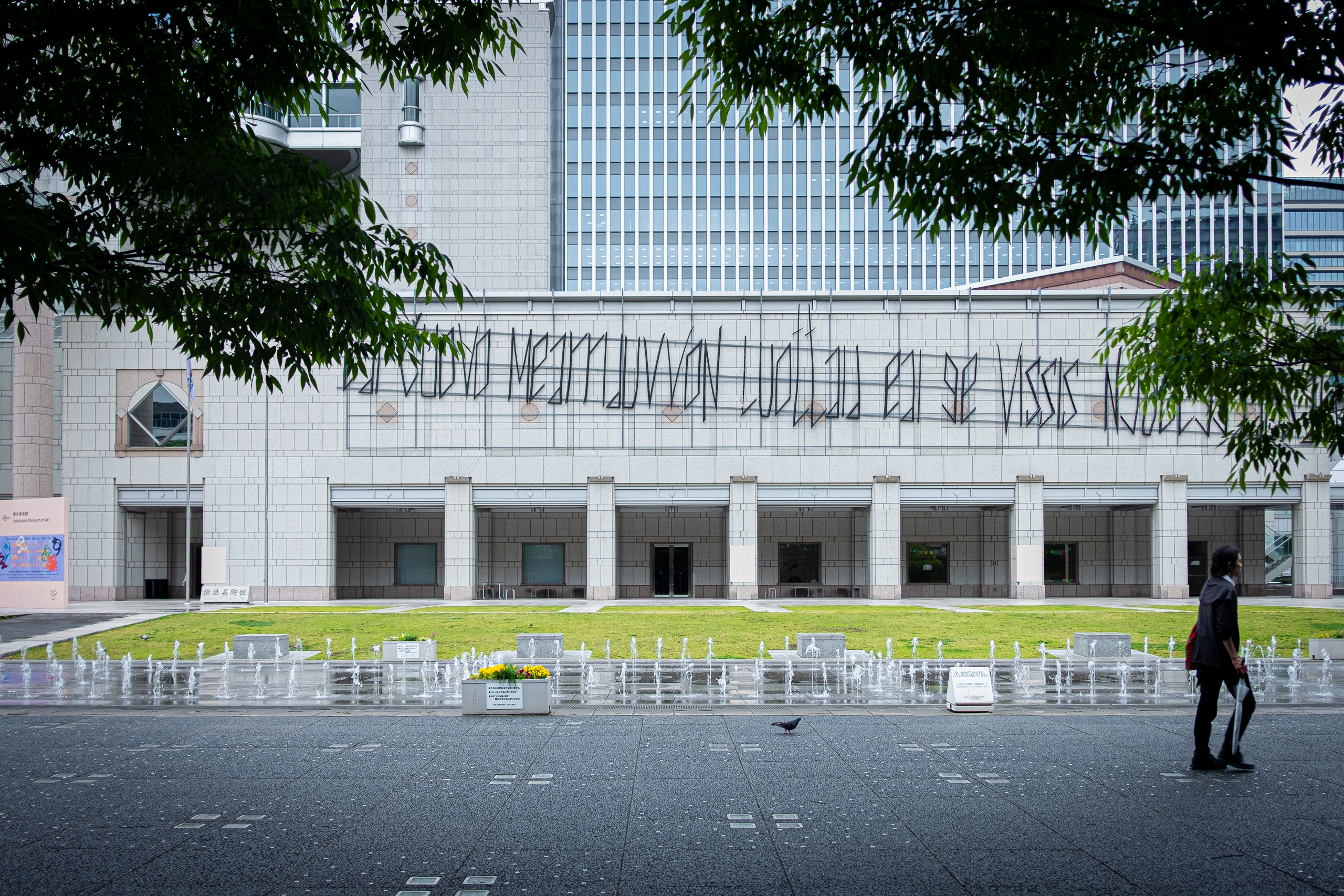
We would like to present a photographic essay documenting the Yokohama Triennale 2023, Wild Grass: Our Lives. The first instalment centres on the Yokohama Museum of Art.
The eighth edition of the Yokohama Triennale concluded not too long ago in June 2024. Originally scheduled to open in December 2023, the Triennale was postponed due to the global semiconductor shortage, eventually welcoming visitors on 15 March 2024. The revised opening date also coincided with the grand reopening of the Yokohama Museum of Art, designed by Kengo Tange1, following a three-year renovation.
I vividly remember my previous visit to the museum during the last edition of the Triennale in 2020 under a light drizzle, one of those damp late-summer afternoons. The entire front façade of the museum was hidden behind some sort of enormous purple veil. Whether it was part of the renovation works or an installation commissioned for the exhibition, I wasn’t really sure. The rain certainly added to the mystery, and the lines are often pleasantly, or sometimes frustratingly, blurred these days in the world of contemporary art, as we all know.
More than three years later, the veil had disappeared. The museum had reopened. The pandemic had already become a relic of the past. Tourism in Japan had resumed and surged, and I found myself back in the city of Yokohama once again. Artistically directed by Liu Ding and Carol Yinghua Lu2, the Triennale is titled, Wild Grass: Our Lives / 野草:いま、ここで生きてる, sharing its name with the anthology of prose poems Wild Grass (野草), published in 1927, written by the renowned modern Chinese writer Lu Xun3, arguably one of the defining figures of modern Chinese literature. Twenty-odd years later, the Triennale unexpectedly offered me another opportunity to revisit the works of Lu Xun, and this time, I would love to see whether the text had changed, or perhaps I had. On the Shinkansen from Nagoya to Yokohama, I tried to recollect and piece together everything I could remember about the book. I must have been twelve, or even younger, when I first read it. And man, I hated it.
“Could you just write properly like a normal human being without being so pretentious?”
I guess it’s fair to say that’s simply what happens when you’re a teenager. Your opinion matters, perhaps a bit too much. The old stuff feels far less significant than the concerns of your own small world, and when the classics are simply shoved down your throat, you are never ready. I remembered there being quite a bit about dreams in the book, one dream within another. Full of allegories and symbolism, so I was taught. There were lots of binary oppositions: dawn and dusk, hope and despair, etc., and of course there was that famous, or infamously notorious line that all of us at school once loathed and despised, being teenagers and all that:
“I can see two trees. One of them is a date tree; the other is also a date tree.”
It is one of those lines that almost every Chinese student remembers, not because everyone thinks it is a brilliant line, but because nobody quite knows what to do with it. What does it even mean?
Now, the curators, who were perhaps also, equally mesmerised by this strange line of text. In turn, the Triennale was crafted in much the same way, with the existence of one thing reflected in two separate things. Namely, the exhibition plan. The presentation at the Yokohama Museum of Art was organised into six principal chapters. Two of them, Fires in the Woods and My Liberation (ironically, photography wasn’t allowed here), appeared twice at opposite ends of the third floor in a mirrored arrangement that utilised the museum’s symmetrical plan. Streams and Rocks and Dialogue with the Mirror occupied the two extremities, while Symbol of Depression sat right in the centre.
Before even stepping inside the museum, however, visitors would undoubtedly encounter the Triennale’s unorthodox lettering set against a purple background. The visual identity set the tone, and could be seen as another interpretation of Wild Grass. The typography resembled hurried handwriting, almost as if it were deliberately resistant to graphic standardisation. Without diving into the designers’ conceptual framework, it looked fun and somewhat different and refreshing, felt entirely appropriate for an exhibition borrowing its title from Lu Xun, and effectively served the purpose. Let’s leave it at that.


Footnotes
1. Kengo Tange (丹下健三, 1913–2005) was one of Japan's most influential postwar architects, known for synthesising modernist architecture with traditional Japanese spatial principles. His major works include the Hiroshima Peace Memorial Museum and Yoyogi National Gymnasium.
2. Liu Ding (刘鼎) is an artist and curator. Carol Yinghua Lu (卢迎华) is a curator and writer. Together, they co-founded the Beijing-based Little Movements and have collaborated on exhibitions and research in contemporary art.
3. Lu Xun (鲁迅, 1881–1936) was a Chinese writer, essayist, and critic widely regarded as the founding figure of modern Chinese literature. Through works such as Diary of a Madman (狂人日记) and The True Story of Ah Q (阿Q正传), he became one of the most influential voices in twentieth-century Chinese intellectual and literary history.