
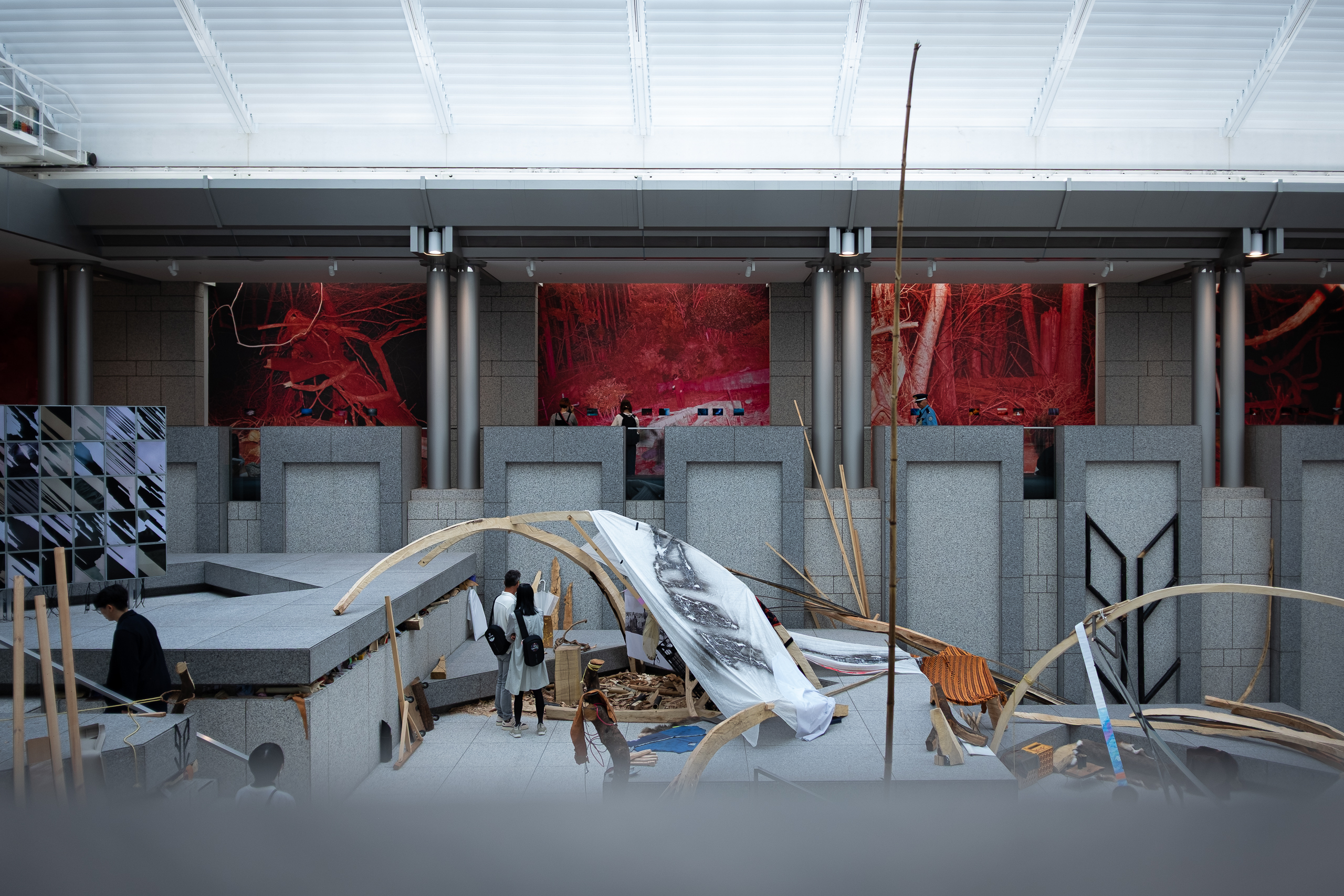

Once you make your entrance to the museum on the second floor, it feels almost as if you are stepping into the lobby of a grandiose modern hotel, one that could make its way into The White Lotus. Instead of Corinthian columns, colossal marble statues, and crystal chandeliers hanging from the ceiling, you are greeted by a sculpture of colliding human bodies and red beetle-like textile installations floating overhead. Before you have even had the chance to breathe, a sharp siren cuts through the space.
The siren comes from a video installation partially occupying the mezzanine between the second and third floors, like a square fountain, dominating the centre of the opening chapter, which shares the same title as the Triennale itself: いま、ここで生きてる — “living here and now”. The work features refugees from eastern Ukraine recreating the sounds of war and the weapons they have learnt to recognise, like a karaoke lesson.
“From the moment we hear the first air raid siren, our ‘internal alarm’ is on alert. It keeps us in constant tension and makes us listen to every sound, every rustle. Sometimes suspicion creeps in even in silence.”
As the centrepiece that virtually everyone is bound to experience, it certainly marks intent. On the other hand, It is, dare I say, annoying as fuck. Again, the intent is clear, and literally quite loud. It asks what “here” and “now” actually mean when everyday life is measured by the sound of an air raid siren and various weapons. Discomfort is precisely the point. The refugees cannot simply walk away from those sounds, unlike the visitors in the museum. The sirens repeat over and over again, as the video loops over and over again, my only instinctive reaction was just to pull its plug and run away.
Obviously I didn’t want to get kicked out, and unfortunately I couldn’t just run away. The sound lingered and echoed well beyond the installation itself. Moving between galleries, it became increasingly difficult to focus and separate one work from another as different soundtracks drifted across rooms, overlapping, interrupting one another, and occasionally collapsing into noise. At rare times this created unexpected connections, at most times, however, it was dreadfully exhausting. What added more fuel to the Fire in the Woods (pun intended), was that one installation created by an avant-garde Japanese artist in 1955, which has become an almost guaranteed presence in every Gutai exhibition. The work does nothing but emit a sharp sequence of metallic rings, causing everyone to flinch, pull their hands away, and look around confused, convinced they had accidentally touched something they shouldn’t have, but just didn’t know what. Watching the visitors react and panic, by this point, had become far more amusing than the actual installation. On a side note, apart from a handful of video works, for better or worse, there was remarkably little to no engagement with digital culture or artificial intelligence at the exhibition, almost like a deliberate avoidance, despite AI being one of the defining conversations of the “here” and “now”.
The entirety of my visit, almost 240 minutes, had gone by in a kind of numb blur. Would I go as far as calling this edition of the Yokohama Triennale another commendable but ultimately lacklustre attempt by Japanese public institutions to churn out yet another contemporary art event? Probably not. Individually, many of the works were excellent in their own right. Together, however, they feel less like a conceptually curated album and more like a random playlist of tracks from the same genre. Did I encounter anything that triggered something in my brain, or something that disturbed the heart, as Jerry Saltz once described the power of art? Well, the noise certainly did disturb, just not in the way I had hoped.
How much had changed: the curators had changed, the city had changed — to a certain extent — some of the restaurants in Chinatown seemed a little more authentic, whatever that word means these days. I had changed too, if only by growing older. Yet something, I felt, had not.
Whether the final exhibition represented a watered-down, softened, comfy version of what the curators had originally envisioned, or whether institutional realities inevitably moulded its outcome — as often as they do, contemporary art exhibitions on this scale hardly escape politics — there’s no way to find out. It is easy to discuss censorship by pointing fingers towards the likes of the PRC, but most countries, Japan included, have many, many of their own invisible boundaries. Aichi 2019 ringing any bells?
I’m not implying censorship here per se, but for years, I have lamented that many biennales and triennales, or even art projects in Japan, are like Disneyland or, if you prefer, the Universal Studios Japan equivalent of contemporary art. They are like a merry-go-round, you are strapped into a safe seat, watching the world’s fractures spin past from a comfortable distance. Despite the gentle ups and downs, you are never allowed to climb off and touch anything. There is, of course, nothing inherently wrong with a merry-go-round, nor must every exhibition turn into a political manifesto. But sometimes, the most memorable experiences aren’t the safest ones. Sometimes, you don’t just want to watch the hurricane from afar — you want to stand close enough to feel the wind, to almost taste the danger. Powerful art and curation don’t always have to comfort, sometimes, they should pull us close, regardless of how uncomfortable it may be.
Many have argued that Lu Xun never really wanted or expected anyone to fully understand Wild Grass, that this personal collection of solitary conversations belonged to him, and him alone. Fair enough. Reading the collection again, more than twenty years after first encountering it, embarrassing as it may be, even now, I still couldn’t honestly say that I truly understand it. Lu Xun’s words have always felt grim to me, there is always a faint scent of despair seeping through the lines, but so too an extraordinary sense of resilience, that even when hope has disappeared and the world has fallen into shit, one must still put one foot in front of the other and keep moving. How do you take that on as the overarching theme of an exhibition? The Triennale appeared to promise something different at first, as it brought together a diverse lineup of artists touching on war, labour, displacement and society, hinting at an exhibition willing to confront the present head-on. Everything was neatly organised and professionally produced. The credits were all there. The job, as always, was done. As joyous and comfortable as a merry-go-round may be, I think it’s time we seriously consider finally stepping off the ride and marching on.


